PhysioFunction becomes Keeogo assessment centre

PhysioFunction has become an assessment centre for the Keeogo dermoskeleton, a bilateral powered knee orthosis for walking and weight bearing activity in individuals with moderate walking dysfunction.
Here, NR Times learns more about the Keeogo and the benefits it brings to euro-rehabilitation.
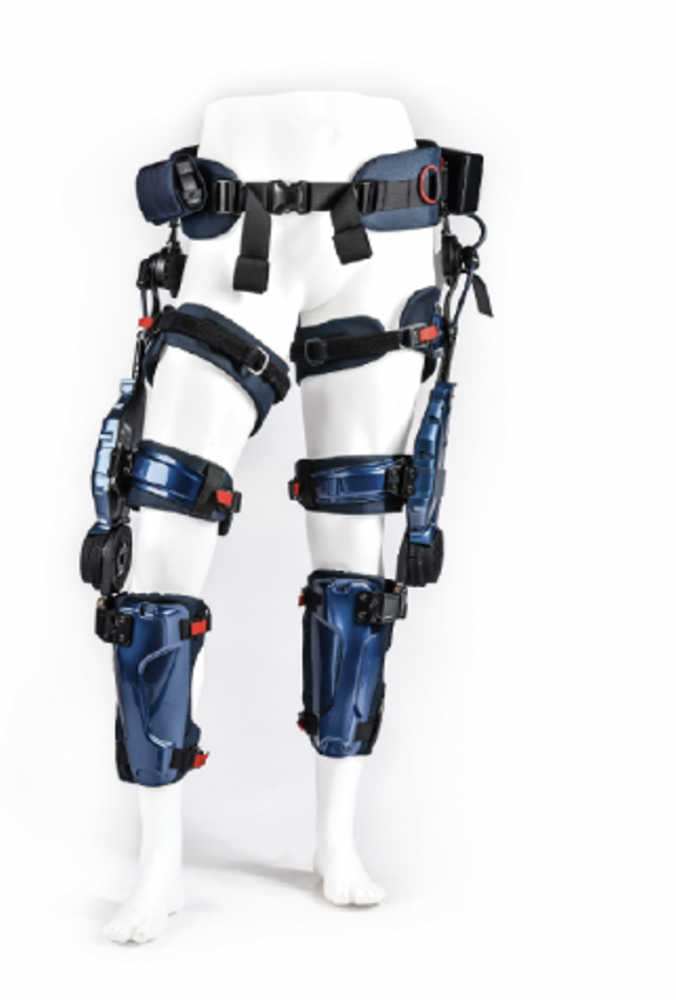

What is Keeogo?
Keeogo is a wearable technology that has been termed a dermoskeleton. It is worn over the top of clothes and consists of a belt which secures the control unit and battery, as well as providing a mount for the leg components. On the leg components there are sensors at the hips and the knees, and motor at the knees. These work in an assistive manner to enable individuals suffering from pain, weakness, or mobility dysfunction to stand, walk, ascend, and descend stairs, as well as complete activities such as kneeling to the floor, squats, and lunges.
The sensors in the hips and knees detect the position of the limbs relative to the body to determine the action (such as walk or climb stairs) that the user wishes to take, so that when they begin to take the action, the Keeogo joins in to support their movement. This helps to reduce effort, improve efficiency, and improve function.
What does the evidence say?
Keeogo is new to the UK as a medical device, but it has been studied for over 5 years in Neurological Rehabilitation settings in Canada.
In 2017 McLeod et al. explored the effects of using the Keeogo in a small sample of participants with various conditions including Stroke, spinal cord injury, Multiple Sclerosis, Cerebellar Ataxia and Cerebral Palsy. From their research they were able to identify ‘responders’ and ‘non-responders’ to the Keeogo and noted that those who benefitted from using the Keeogo had moderate impairments, characterised by a Berg Balance Scale score of 46-51 or Timed Up and Go Score of 8-12 seconds. Those scoring better or worse than this were either too functional or too impaired to benefit from using the Keeogo.
As an extension, this study also performed an individual case study on a stroke survivor who had used the Keeogo for 12 months as a functional aid, and identified that when using Keeogo, she was able to stand, walk and climb stairs almost equally well as an age matched control subject, and almost twice as well as she was able without the Keeogo.
Since this seminal work, further randomised studies have demonstrated positive therapeutic effects on walking endurance and stair climbing following two weeks’ use in participants with Multiple Sclerosis (McGibbon et al., 2018), with usage linked improvements in self-reported quality of life and disability measurements in the same population (McGibbon et al., 2021) compared to no use and statistically significant improvements in memory and gait endurance in participants with Parkinsons, completing a twice weekly exercise program with the Keeogo compared to without (Gryfe et al., 2022). McGibbon et al., (2021) also studied participants with knee osteoarthritis, and found modest improvements in stair climbing ability and knee pain with and without the device after a usage period of two weeks, compared to the same period of no use.
Whilst this evidence offers promising support to use of the Keeogo in both neurological and orthopaedic population, further larger scale research is required to ‘prove’ the benefit of the device.
Case Study
Mrs S was diagnosed with femoral nerve damage following a total hip replacement, which left her with profound sensory loss and muscle weakness in her right thigh and hip. Due to having to compensate with her left leg for the weakness, she developed early osteoarthritic changes in her left hip which causes pain and impairs her ability to stand and move around on her feet.
Keeogo was selected as a means of supporting and allowing her to bear more weight through her right leg, thus offloading her left hip to reduce pain and prevent further degeneration.
Within her first session Mrs S was able to weight bear through her right leg with light hand support, which had not been possible previously other than using an AlterG anti-gravity treadmill with 50% bodyweight support. She has since completed further sessions in the Keeogo and has now been able to walk without any balance assistance for the first time since her surgery.
To access the Keeogo or for further information
Contact PhysioFunction by email at [email protected] or by telephone on 01327 842321.
References
Gryfe, P., Sexton, A. and McGibbon, C.A. (2022). Using gait robotics to improve symptoms of Parkinson’s disease: an open-label, pilot randomized controlled trial. European Journal of Physical and Rehabilitation Medicine.
McGibbon, C.A., Sexton, A., Jayaraman, A., Deems-Dluhy, S., Gryfe, P., Novak, A., Dutta, T., Fabara, E., Adans-Dester, C. and Bonato, P. (2018). Evaluation of the Keeogo exoskeleton for assisting ambulatory activities in people with multiple sclerosis: an open-label, randomized, cross-over trial. Journal of neuroengineering and rehabilitation, 15(1), pp.1-14.
McGibbon, C., Sexton, A., Gryfe, P., Dutta, T., Jayaraman, A., Deems-Dluhy, S., Novak, A., Fabara, E., Adans-Dester, C. and Bonato, P. (2021). Effect of using of a lower-extremity exoskeleton on disability of people with multiple sclerosis. Disability and Rehabilitation: Assistive Technology, pp.1-8.
McGibbon, C., Sexton, A., Jayaraman, A., Deems-Dluhy, S., Fabara, E., Adans-Dester, C., Bonato, P., Marquis, F., Turmel, S. and Belzile, E. (2021). Evaluation of a lower-extremity robotic exoskeleton for people with knee osteoarthritis. Assistive Technology, pp.1-14.
Mcleod, J. C., Ward, S. J., & Hicks, A. L. (2019). Evaluation of the Keeogo™ dermoskeleton. Disability and Rehabilitation: Assistive Technology, 14(5), 503-512.