




When the Christopher & Dana Reeve Foundation first told the world it wanted to cure spinal cord injury and end paralysis, the gap between its own ambitions and what the technology of the day was capable of seemed insurmountable.
Yet this goal, which the 41-year-old foundation has unshakably continued to pursue, is edging ever closer to the dimension of the possible.
Leading from the front is ONWARD, the spinal cord stimulation tech firm that has made huge strides in recent years, as reported by NR Times.
ONWARD made global headlines when three spinally-injured patients implanted with its epidural electrical stimulation (EES) system were able to take steps independently within a single day. After five months of rehabilitation, they were also able to use their legs to stand, walk, swim, and/or cycle. They also regained control of their trunk muscles.
It is now developing two technology platforms, ARC-EX and ARC-IM, for which the FDA has granted a total of eight Breakthrough Device Designations (BDDs). BDDs are designed to help patients and their physicians receive timely access to technologies that have the potential to provide more effective treatment or diagnosis for debilitating conditions of significant unmet need, such as spinal cord injury.
ARC-EX is a non-invasive platform with a stimulator and a wireless programmer. It has BDD status for use in improving upper and lower limb function, for bladder control and blood pressure regulation and for alleviation of spasticity in people with spinal cord injury.
Last year the first large-scale clinical study of non-invasive spinal cord stimulation technology, ‘Up-LIFT’, achieved its “primary safety and effectiveness endpoints of improvement in upper extremity strength and function after a spinal cord injury”.
ONWARD believes the therapy may be approved for commercialisation towards the end of this year.
The implantable platform ARC-IM, meanwhile, sees a neurostimulator (IPG) and lead placed near the spinal cord. It is controlled by wearable components and a smartwatch.

The ONWARD team: Professor Gregoire Courtine, Dr Jocelyne Bloch and CEO Dave Marver
BDD status was received in 2020 to restore leg motor function in people with spinal cord injury. Then in 2021, for the use of the system to normalise blood pressure and provide trunk stability, and in 2022 for bladder control.
Last month, upon receipt of ONWARD’s eighth BDD, for ARC-EX, CEO Dave Marver said: “Bladder control, spasticity, and blood pressure dysregulation are three of the many challenges people with spinal cord injury must manage in order to navigate their daily lives.”
And in a recent interview with NR Times, Marver set out ONWARD’s mission to “scale these therapies so they can provide benefit to hundreds of thousands of people with spinal cord injury around the world”.
While ONWARD may be the most advanced on its journey towards commercialisation and, more importantly, mass patient usage, however, not all hope for the future of spinal injury solutions is solely heaped on the backs of its pioneering engineers, scientists and physicians.
Pockets of research and development elsewhere, enabled by the quickening progress of technology and bio and life sciences, also give reasons for optimism among spinal injury professionals; and the families and individuals they work with.
Last month the Praxis Spinal Cord Institute in Vancouver announced the latest cohort of its Spinal Cord Injury (SCI) incubator programme, following a global call for innovations.
The institute’s vision is “a world without paralysis after SCI” and its aim is to advance research and innovation worldwide through networks of international researchers, healthcare professionals, clinical trials, entrepreneurs and investors. The programme aims to advance SCI-focused start-ups towards commercialisation.
Among the cohort is Battelle’s NeuroLife wearable sleeve technology, which allows measurement of the nerves and muscles of the forearm with high resolution and in real-time.
This is designed to enable “targeted stimulation interventions” that recreate complex, dexterous hand movements.
Also selected was inContAlert, which helps patients with incontinence to monitor the filling level of their urinary bladder.
Wearable technology scans the bladder unobtrusively throughout the day.
Machine learning algorithms developed using the patient’s data can then generate an alert when a predefined filling level is reached. This minimises the risk of leakage and harmful over-distension of the bladder.
Joining them on the programme is Vancouver-based Focal Lines Technologies, which brings together smart material development, remote health technology and virtual care. Its “e-textile sensor system”, based on novel nanomaterials, connects and monitors patients remotely to provide insights that can enable informed rehab, helping individuals to regain independence.
Smart materials as a potential tool in spinal injury rehab are being explored by scientists elsewhere too.
Researchers at the University of Limerick, Ireland, reported in December that they had successfully synthesized new hybrid biomaterials to promote repair and regeneration after spinal cord injury.
They used a new kind of scaffolding material and an electrically conducting polymer composite to promote new tissue growth and generation that could advance the treatment of spinal cord injury.
Researcher Professor Collins said: “The field of tissue engineering aims to solve the global problem of shortages of donated organs and tissues, in which a new trend has emerged in the form of conductive biomaterials.
“Cells in the body are affected by electrical stimulation, especially cells of a conductive nature such as cardiac or nerve cells.
Lead author Aleksandra Serafin added: “Raising the conductivity of biomaterials to develop such treatment strategies typically centers on the addition of conductive components such as carbon nanotubes or conductive polymers such as PEDOT:PSS, which is a commercially available conductive polymer that has been used to date in the tissue engineering field.
“Unfortunately, severe limitations persist when using the PEDOT:PSS polymer in biomedical applications. The polymer relies on the PSS component to allow it to be water soluble, but when this material is implanted in the body, it displays poor biocompatibility.
“This means that upon exposure to this polymer, the body has potential toxic or immunological responses, which are not ideal in an already damaged tissue which we are trying to regenerate. This severely limits which hydrogel components can be successfully incorporated to create conductive scaffolds.”
Novel PEDOT nanoparticles (NPs) were developed which enabled the team to overcome this limitation.
Hybrid biomaterials comprising of gelatin and immunomodulatory hyaluronic acid were combined with the developed novel PEDOT NPs to create electroconductive scaffolds for targeted spinal cord injury repair.
“The introduction of the PEDOT NPs into the biomaterial increased the conductivity of samples. In addition, the mechanical properties of implanted materials should mimic the tissue of interest in tissue-engineered strategies, with the developed PEDOT NP scaffolds matching the mechanical values of the native spinal cord,” explained the researchers.
Biological responses to the developed PEDOT NP scaffolds were studied with stem cells in-vitro and in animal models of spinal cord injury in-vivo. Excellent stem cell attachment and growth on the scaffolds were observed, they reported.
Testing showed greater axonal cell migration towards the site of spinal cord injury, into which the PEDOT NP scaffold was implanted, as well as lower levels of scarring and inflammation than in the injury model which had no scaffold, according to the study.
These results offer encouraging prospects for patients and further research into this area is planned.
The Nasdaq-listed spinal cord injury treatment firm InVivo, meanwhile, continues its work to validate its Neuro-Spinal Scaffold device.
Recent news suggests, however, that progress at the company has been slower than expected.
Last week it announced topline results from its INSPIRE 2.0 study – designed to evaluate the safety and probable benefit of its bioresorbable scaffold device for patients with acute SCI.
But the study did not meet its primary endpoint, which was assessed by the proportion of treated patients achieving an improvement of at least one American Spinal Injury Association (ASIA) Impairment Scale (“AIS”) grade at six months post-scaffold implantation, versus a control group that received standard of care surgery.
CEO Richard Toselli said: “We are disappointed by the outcome of this study as treatments for spinal cord injury are so urgently needed and we know many in the SCI patient and advocate community wait in hope for therapeutic options.
“We have rigorously pursued the science and believe that, upon full assessment, the INSPIRE 2.0 data set will provide a significant addition to the clinical literature around the treatment of SCI.
InVivo said it would now conduct a full assessment of the study data set and plans to share its findings in full in a peer-reviewed medical venue at a later date. It will also evaluate its strategic options and provide an update on corporate direction when appropriate. Time will tell whether the clinical-stage firm can get progress back on track and fulfill its potential to transform spinal injury outcomes globally.
While ending paralysis is the ultimate goal of the global spinal injury research collective, removing other barriers in the lives of people with spinal injuries is also a constant focus area.
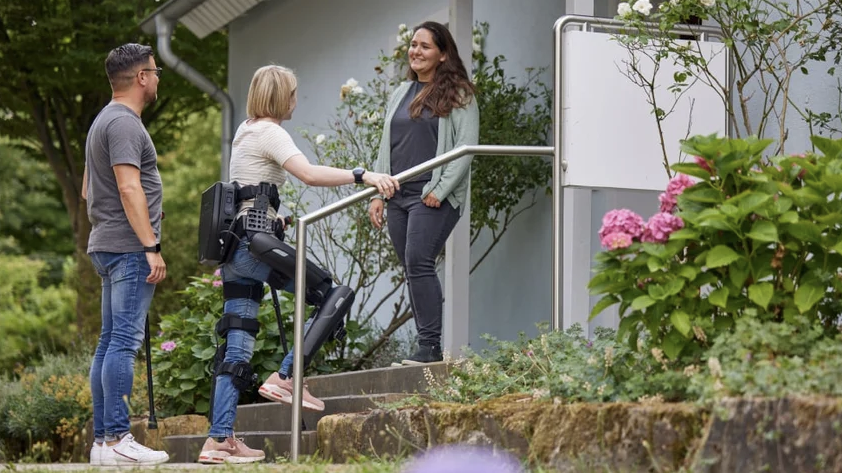
Robotics firm Rewalk last week achieved something of a breakthrough on this front in the influential US market.
Its exoskeleton system received FDA clearance for its device to be used in climbing stairs and curbs. Previously FDA-authorisation of exoskeletons covered use on flat ground only.
CEO Larry Jasinski said: “Our mission at ReWalk has been to achieve widespread access to the health benefits of walking in everyday life for individuals with spinal cord injury. Today’s announcement demonstrates our commitment from a technical perspective to improve access to a broader range of activities of daily living, such as walking up the steps to visit a friend’s home or stepping over a curb during a neighborhood walk.”
Also making headlines for contributions to improving life quality for people with spinal injuries is the Male Fertility Research Program at The Miami Project to Cure Paralysis.
The initiative was last month awarded a US$3.25m grant by the Department of Defense for a four-year study on the use of an oral medication to treat an infertility issue that affects most men with spinal cord injury.
It is hoped that the results of the trial could “drastically improve the options for men with spinal cord injuries who want to have biological children”, said profgramme director, Dr Emad Ibrahim.
Nearly eight in 10 spinal cord injuries occur in men, and the average age that men experience such an injury is 43 — when many might consider having families.
But most men with spinal cord injuries, whether they become paraplegics or tetraplegics, suffer from erectile dysfunction and the inability to ejaculate, leading to infertility.
“These men are either unable to produce enough sperm, or the majority of sperm they do produce are dead,” Dr. Ibrahim said.
He and colleagues have been studying the fertility issues that men with spinal cord injury face since Dr. Ibrahim joined the Miller School in 2004.
Through the years, they have found that spinal cord injury leads to inflammation, and the body reacts by producing substances called cytokines.
“These cytokines are toxic to sperm,” Dr. Ibrahim said.
The Miller School researchers, including neuroscientists from The Miami Project, studied ways in which to eliminate or at least minimize the effect of these cytokines on sperm, and discovered that there is another component to the cascade of events: a multi-protein complex called the inflammasome that results in activation of these toxic cytokines.
“A medication called probenecid that has been used for years to treat gout has been found to block this cascade, preventing the inflammasome complex from activation and hence lowering or minimizing the amount and concentration of cytokines in the body,” Dr. Ibrahim said.
“Studies on probenecid have shown it to be safe and effective. It’s also very inexpensive.”
Read more spinal injury stories here.


