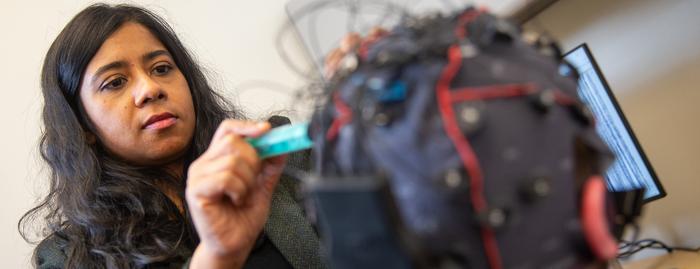
Advancing TBI rehab with cognitive motor training and neuromodulation enhanced robotics

Kessler Foundation research scientists have been recognised for their pioneering work in enhancing rehabilitation strategies for individuals with traumatic brain injury (TBI) with $3.4m in grant awards from the Congressionally Directed Medical Research Programs (Department of Defense).
The grants will support two groundbreaking studies aimed at improving gait, balance, and overall quality of life for individuals affected by TBI.
The grants have gone to Kiran Karunakaran, PhD, and Vikram Shenoy Handiru, PhD, research scientists in the Foundation’s Center for Mobility and Rehabilitation Engineering Research.
Dr. Karunakaran has been awarded $2,727,158 for a four-year study.
TBI impairs both cognitive and sensorimotor functions with debilitating after-effects on gait and balance, persisting even during the chronic stages of recovery. Deficits in these motor and cognitive functions result in decreased overall quality of life and activities of daily living.
“Evidence suggests that cognitive function capacity is vital to physical function, and cognitive effort contributes to motor recovery,” explained Dr. Karunakaran.
“Our study aims to strengthen the inseparable link between cognitive and sensorimotor control using virtual reality to deliver the novel cognitive integrated sensorimotor training.
“This intervention will result in improved and efficient recruitment of cognitive and sensorimotor brain regions during gait and balance and will likely result in improved and efficient gait and balance function and in reduced falls.”
Ambulation involves a number of tasks while walking and balancing in the real world, complete with obstacles.
“These tasks include being able to perform healthy gait cycles, while paying attention to the environment, assimilating and processing the information, reacting effectively to produce efficient movement, avoiding any obstacles, and preventing a fall,” said Dr. Karunakaran.
The study will use cognitive integrated sensorimotor training with virtual reality to improve functional ambulation.
The study will enrol 135 participants with TBI who will be randomly assigned to one of three training groups: 1) personalised cognitive integrated sensorimotor virtual reality or augmented reality training, 2) traditional dual-task training, and 3) standard of care.
Each group will receive 12, one-hour training sessions for four weeks. Participants will complete three data collection sessions: baseline, post-training, and follow-up after one month post-training.
This study will comprehensively and quantitatively evaluate the changes in biomechanics, neurophysiology, cognition, and examine their relation to functional gait & balance and community participation.
“The mobile neuroimaging technique functional near-infrared spectroscopy will be used to understand the cortical activity changes while performing a dynamic task (such as walking) to help us understand the relationship between functional, biomechanical, and training-induced cortical changes,” said Dr. Karunakaran.
Improve postural control in TBI
Dr. Shenoy Handiru received $718,090 for his project. The research combines robotic balance training with non-invasive brain stimulation techniques to enhance neuroplasticity and motor recovery in individuals with TBI-related balance impairments.
TBI often leads to impaired balance and postural control, increasing the risk of falls, reducing mobility, and impacting daily life.
“To address this issue, we propose a novel approach combining a robotic balance platform called hunova (developed by Movendo Technology, Genova, Italy) with a non-invasive brain stimulation technique called high-definition transcranial direct current stimulation (HD-tDCS),” said Dr. Shenoy Handiru.
“The scientific premise for this approach is that the HD-tDCS, a targeted brain stimulation protocol, will help strengthen the top-down, brain-to-muscle signals by priming the motor cortex, while the robotic platform will provide targeted balance training and enhance the sensory feedback from the lower-limb muscles to the brain.”
Dr. Shenoy Handiru’s three-year study plans to enrol 45 individuals with TBI-related balance issues who will be randomly assigned to one of three groups: (1) robotic balance training with active HD-tDCS, (2) robotic balance training with sham HD-tDCS, or (3) standard rehabilitation.
“The intervention will consist of 12 sessions over four weeks. We will assess balance, gait, and neurophysiological responses [using Electroencephalography (EEG), Electromyography (EMG), and transcranial magnetic stimulation (TMS)]) at baseline, immediately after four-week intervention, and at a two-month follow-up,” explained Dr. Shenoy Handiru.
“This comprehensive evaluation will help us determine the effectiveness of the combined treatment and inform the development of personalised rehabilitation protocols.”
Both studies represent significant advancements in TBI rehabilitation, offering hope for improved outcomes and quality of life for those affected by this debilitating condition.