Neurofeedback has been used since the 1960s, becoming a mainstay in the world of alternative medicine but 50 years on, the method is yet to be accepted by mainstream science. Now, tech companies are bringing the divisive brain training method into the home.
Earlier this year at the 2023 Health Optimisation Summit, a Canadian tech company unveiled a device that it says can optimise the brain and help you control your state of consciousness.
The technology is underpinned by the concept of neurofeedback, a non-invasive method for consciously training and controlling brainwaves. Recordings of brain activity – or electroencephalograms (EEG) – are fed back to users in visual or auditory form.

Its efficacy is disputed by scientists but throughout its history, the alternative therapy has retained a strong group of advocates.
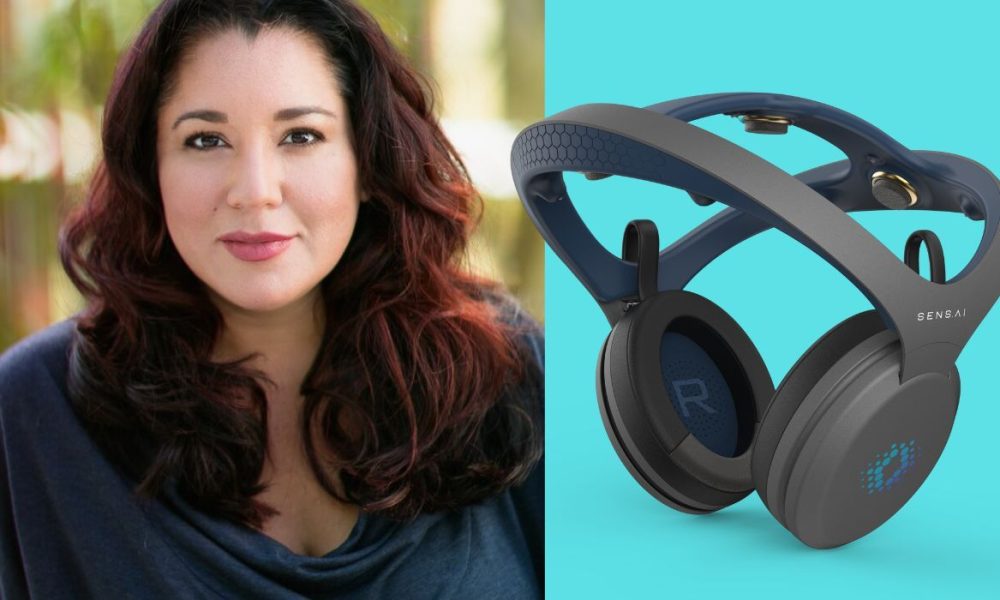
Sens.ai, is led by CEO, Paola Telfer, a tech entrepreneur and electrical engineer whose interest in brain optimisation stems from an injury that led her to a “low point” in her life.
Seven years ago, Telfer was involved in a car accident on the way to her home in Whistler, Canada. The collision left her with a concussion, PTSD and musculoskeletal issues that eventually required neck surgery.
The impact on her life was significant. Telfer was running a tech company at the time and raising a young child. The implications of the accident prevented her from “keeping her side of the bargain”, she said. “I wasn’t really able to contribute to what I felt like I needed to do in the house with my husband and my child. It was very, very frustrating.
“I was really at a low point. I wasn’t at my best self at all because I was so frustrated. I also had a lot of sensitivity to light and sound, so I became quite introverted.”
She experimented with a range of treatments as she searched for the root of her persisting health issues. She cycled through treatments like massage therapy, chiropractic therapy, physio and others before coming to a realisation.
“Trying all these things and spending all this money, I realised that it was a lack of connection between my mind and my body,” Telfer said. “My body didn’t know that the motor vehicle accident was over.”
Telfer remembers her body feeling clenched and in a constant state of hypervigilance that she believes was preventing her from receiving therapy.
Tefler then turned to mind exercises with the hope that it would allow her body to let go of the trauma. However, as a long-term meditator, she became frustrated as her years of practice failed her.
She tried other alternative medicine providers until she came across neurofeedback, a method that she claims helped her enter deep meditative states that contributed to her recovery and allowed her to “rewire the stories” around the car accident.
Not only did the therapy contribute to her recovery, it also sharpened her mind, Telfer said.
“I was running a tech startup and I felt kind of renewed, cognitively,” she said. “That’s coming from a concussion, too. I came back stronger and I realised I could tap into these various meditative states that I knew, but now I could consistently and predictably get there.”
Telfer puts this down to a specific part of neurofeedback called alpha-theta training. This method was developed to allow people to prolong the state of hypnagogia, a transitional stage between wakefulness and sleep.
Enamored with the world of neurofeedback, Telfer questioned why the technology hadn’t taken off. So, she took it upon herself to create a device that could bring neurofeedback into a home setting.
Telfer continued: “It was with the idea of making the technology that I had experienced in my personal recovery from the motor vehicle accident [and] making it smaller, making it easier to use, making it more accessible to the masses without it having to be in a clinical environment.”
Described as a five-in-one brain training system, the Sens.ai device combines neurofeedback with light stimulation – known as transcranial photobiomodulation – which is being touted as a promising treatment for psychiatric and neurological conditions.
Users’ progress is tracked by “event-related potentials”, which assess functional change via electrodes installed in the headset. “We give you something that looks like a Nintendo Switch with a couple of buttons,” Tefler explained. “You’re pushing these buttons to this test for about 10 minutes and during that time, we’re measuring the speed of your processing.”
Neurofeedback is no stranger to critics
According to its website, Sens.ai is on a mission to build a community of “superconscious people” but with a lack of research studies to back up the technology, the concept has been met with scepticism from some scientists.
Although neurofeedback is widely believed to be safe, it is not universally accepted as an effective method for improving cognitive function.
The technique can be traced back to the 1960s and ’70s when scientists discovered that experienced meditators displayed high levels of alpha brainwaves.
This brain activity is associated with relaxed, meditative, sometimes trance-like states of consciousness.
One of the field’s most vocal critics was the scientific sceptic and psychology professor, Barry Beyerstein. In the 1980s and ‘90s, he published work that refuted claims that the presence of alpha waves induced a meditative state.
He also argued that belief in the technology contributed to the success of the brain training technique.
Critics continue to question the technology 50 years on since its inception.
This is in part due to a lack of high-quality studies.
To date, most studies exploring EEG feedback lack control groups and blinding, meaning participants are aware they are receiving the training and thus more likely to experience placebo effects.
Speaking to the Sunday Times, Anabelle Singer – a professor at Georgia Tech whose research focuses on restoring neural activity – said the brain optimisation industry needs to be backed up by more research.
Singer said: “There’s potential but to realise that potential we need to see rigorous studies using exactly the technology they’re proposing. I would want to see a trial study with a control group who got a sham stimulation.”
Nilly Lavie, professor of psychology and brain sciences at University College London, told the paper that devices like Sens.ai are “not ready for the market right now”.
She said she is “interested in the possibilities” of light stimulation, but devices like these are “not ready for commercial use.
While Lavie acknowledged the promise, she believes the industry is jumping the gun with promises of enhanced brain function.
Embracing the scepticism
Telfer does not shy away from this scepticism. She believes it’s “healthy”, especially if it is coming from a place of scientific rigour.
But this rigour can be limiting, Telfer said. “The balance is, can we do this safely in a way that we know is helping people? […] I think we can very comfortably say it’s a very non-invasive technology.
“We’re very careful about making claims as well. We’re really trying to conduct ourselves with a lot of integrity in this space.”
One reason why the efficacy of neurofeedback has continued to be debated over the last five decades is the nature of the method, Tefler said. “Part of the gap is that neurofeedback as it is conducted in clinics has to be personalised and personalisation doesn’t jive with what needs to happen in a scientific method at scale.
“Studies have been done successfully with neurofeedback historically. The question is, has it been done with controls? Has it been done at scale? Is it really replicable?”
The Sens.ai device was beta-tested in its test community prior to the launch and has the backing of several high-profile scientists in the neurofeedback and neurology fields, including James Doty, a clinical professor of neurosurgery at Stanford, Jay Gunkelman, the past president of International Society for Neurofeedback & Research and Dr Estate (Tato) Sokhadze, a research scientist and president of the Foundation for Neuromodulation and Neurofeedback Research.
“One of the reasons I think that Dr. Jay [Gunkelman] and Dr Tato saw promise in what we were doing and the approach we were taking, is that it is personalised in an algorithmic way. It is based on 50 years of studies and what is best known in the field.
“But it is also not having the arrogance of assuming we know everything. [We] know we have to learn. Just because it worked for 20 people or 30 people, can it work for 30,000? Can we really scale this? How will this compare across populations and across cultures?
“Those are questions that we hope to answer. We’re building a community that believes we can do some good with this sort of data collection.”
Democratising EEG
The scale of the mental health crisis is a key reason why Telfer believes devices like Sens.ai are needed now and by bringing the technology into the home, Tefler hopes that it will help democratise this alternative therapy.
Sessions at neurofeedback clinics come with hefty price tags. You can expect to pay upwards of £100 per 30-minute session.
“It’s the same technology that’s there in clinics internationally right now, which people are paying big bucks for,” Tefler said.
“Right now it’s reserved for the elite. It’s reserved for professional athletes and it’s reserved for executives. What we’re doing is using that same tech but for the regular people.”
Sens.ai is by no means cheap, with a price tag in the ballpark of £1,000. Whether this is accessible for the “regular” person is up for debate, but it will allow early adopters of brain-optimising tech to get more for their money.