Breakthrough stimulation therapy restores arm and hand function after 34 years
Alan*, 52, has regained strength, mobility and function in his left shoulder, arm and hand 34 years after experiencing partial paralysis following a spinal cord injury as a teenager.
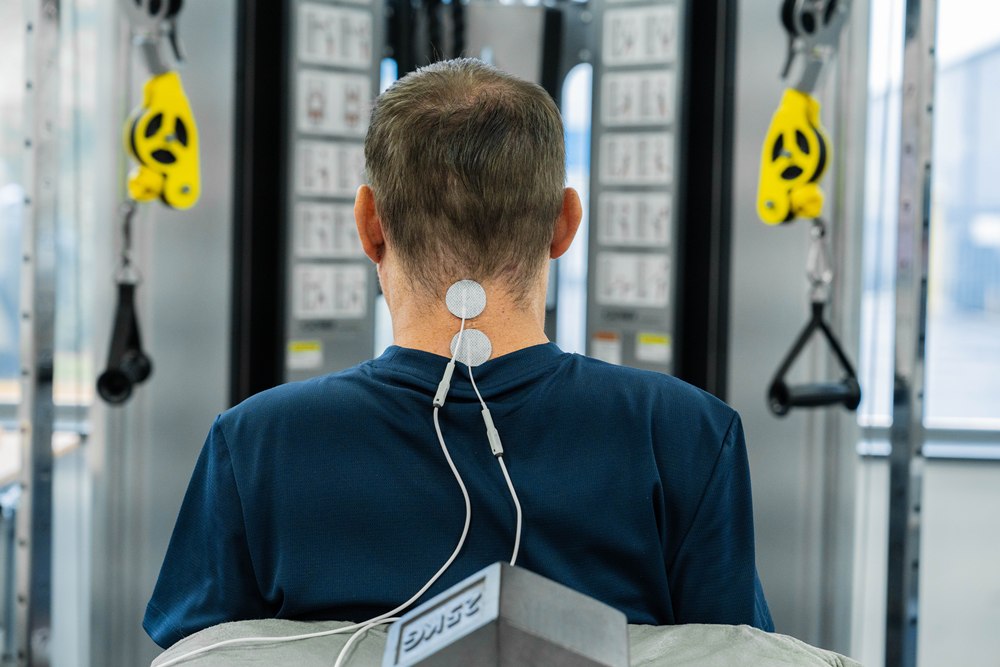
He achieved these gains by completing a groundbreaking eight-week programme combining ONWARD Medical’s newly-approved ARCEX spinal stimulation system with the Neurokinex Activity Based Rehabilitation protocol.
One of the first people in the UK to complete this programme, he wants to share his experience to bring hope to others.
Rare spinal cord injury
In November 1988, 17-year-old Alan was preparing to sit his A levels ahead of studying engineering at university when he sustained a Brown-Séquard spinal cord injury at the C3–C6 (neck) level.
A rare clinical presentation when one half of the spinal cord is damaged, or ‘hemisected’, it causes a distinct pattern of motor weakness on one side of the body and sensory loss on the other.
Finding himself in hospital instead of revision classes, Alan never returned to school. He did, however, successfully sit his A Levels that summer and secured a place at Cambridge University to study law which he deferred for a year to focus on his rehab at Stanmore.
By the time he went to university in 1989, Alan was walking with the aid of a stick and had adapted to life relying on the 50 per cent of his body that he could use.
Groundbreaking opportunity
Now a married father of two who works full time as a director in the corporate tax team at a leading accounting company in the City, Alan never thought he would achieve further recovery so long after his injury.
He was fascinated to hear about the ARCEX System becoming available in the UK and encouraged by its positive research on upper limb recovery.
However, no-one on the study had an injury as old as his so he was unsure how much it could help.
The ONWARD ARCEX System is a non-invasive spinal cord stimulation system for people with a chronic cervical spinal cord injury (SCI) which has shown in a pivotal clinical trial to improve hand sensation and strength.
It is designed to be used in a rehabilitation centre setting while clients practice tasks of daily living.
Neurokinex is the first in the UK to provide this option to its clients.
Taking the opportunity of a break between jobs, Alan was among the first in the country to undertake the eight-week programme that combines the ARCEX Therapy with Activity Based Rehabilitation at Neurokinex Hemel.
First rehab since 1990
Alan started at Neurokinex having not participated in structured rehabilitation since 1990.
At his initial assessment, he showed good strength and functional use of his right upper limb, enabling partial independence with basic daily activities.
However, he presented with significant challenges on the left side, including no functional use of the left upper limb which presented with a severe wrist drop, dysfunctional reach pattern with marked compensatory trunk and shoulder elevation and pronounced postural deficits such as increased kyphosis and scoliosis.
These postural issues further restricted his upper limb function.
Additional impairments included marked weakness throughout the left upper limb and trunk, bilateral foot drop and increased tone in both lower limbs.
While he could mobilise very short distances using a rollator frame, poor positioning of his left-hand alongside his poor foot placement and overall lower limb control limited effectiveness and he primarily relied on a mobility scooter.
“Our rehabilitation approach focused on unlocking functional recovery in the left upper limb while simultaneously improving core strength and postural control,” explains Catarina Carvalho, Clinical Lead Neuro & Spinal Physiotherapist at Neurokinex.
“By integrating our activity-based rehabilitation programme with ARC Ex stimulation, we were able to actively facilitate neuromuscular engagement and promote meaningful, task-specific movement.
“Sessions included a range of targeted exercises such as multi-directional grasp-and-release activities, fine motor tasks like object retrieval from a rice box and progressive weight-bearing exercises including supported and standing wall push-ups.
“Strengthening work in reclined positions, including chest press and shoulder flexion, was used to build proximal stability and support functional movement patterns.”
“The sessions felt like hard work but I enjoyed the process and was driven to achieve all I could in the time I had there,” says Alan.
“The challenge was psychological as well as physical as I had to concentrate hard to activate my fine motor skills while working the larger muscles in my shoulder and arm.
“It helped that I started to notice changes as early as my second session which reinforced that what I was doing was worthwhile.”
Rapid and encouraging response
Alan’s response to treatment was both rapid and encouraging. Even after the first session, there was a noticeable improvement in his left wrist positioning.
Within the first week, he could independently maintain a neutral wrist alignment, an important milestone that translated directly into improved hand function.
This early progress enabled greater control during grasping tasks and allowed him to begin manipulating objects with minimal therapeutic support.
“By the end of the eight-week programme, the transformation was significant. Alan demonstrated marked improvements in wrist stability, grasp-and-release control and functional reach, alongside increased strength throughout the upper limb.
“Enhanced trunk control and posture further supported these gains, leading to more efficient and coordinated movement,” says Catarina.
Meaningful real-world outcomes
Most importantly, these clinical improvements translated into meaningful real-world outcomes.
Alan is now able to use his hand functionally for the first time in decades to type with both hands, hold and manipulate objects, use cutlery, carry a plate and handle his phone with ease.
“I had forgotten how to use my shoulder, arm and become used to using my right arm and hand for everything. I had to really focus on practicing things with my left arm and hand and realised the more I used them, the stronger they would become. Although it was slower using my left side, I made myself do this to build it up.”
Lifechanging gains
Alan’s experience highlights the powerful impact of combining advanced neuromodulation technology with targeted, activity-based rehabilitation to drive functional recovery, even many years after injury.
“I was injured so long ago and didn’t think it possible to regain function after so many years,” says Alan.
“I would like to thank the Neurokinex for the excellent approach, dedication and positivity. Skilfully combining the ARCEX System with their Activity Based Rehabilitation approach has literally changed my life.”
*name changed at the request of this case study to respect his privacy
Find out more about Neurokinex at neurokinex.org