



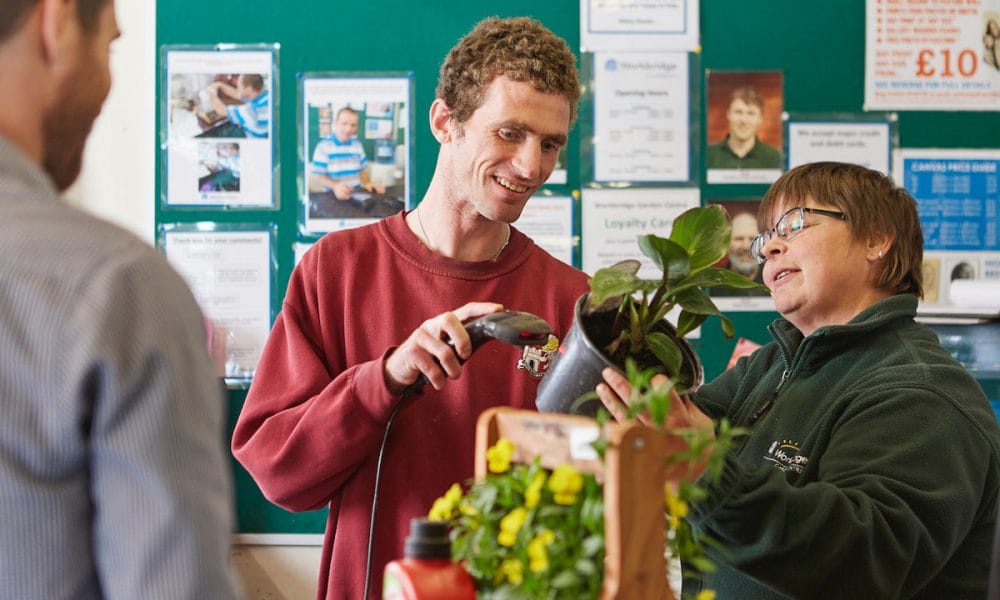
“Being at Workbridge gives the person a sense of purpose. It provides them with an aim to achieve. They can stand back and be proud of what they’ve done,” says Tom, a service user accessing Workbridge at St Andrew’s.
Based within the St Andrew’s Northampton hospital site, and integrating public facing retail offerings, Workbridge provides a vocational pathway for people living with brain injuries, mental illness, learning disabilities or autism.
The centre operates to provide training and social opportunities for people living in the community and within the inpatient setting of St Andrew’s and here people can learn new skills through the array of activities on offer, supported by vocational skills instructors.

Departments ranging from ceramics to woodwork, horticulture to catering, allow service users to learn both life and work skills, building confidence and social capability in the process.
The products made in the workshop sessions are sold in the public-facing garden centre, charity and coffee shop where service users can also work, meeting the public and learning retail skills.
Workbridge has helped hundreds of people to gain or regain skills and build their confidence and independence over the 41 years since it was established.
Tom, who accesses the centre as a community based service user is a regular and an enthusiastic advocate of the service.
“I’m sure everyone benefits from being here, but that’s quite subjective and down to the individual, but for me the consistency it gives me has been really important,” he says.
Having sustained two brain injuries – the first in 2001 as the result of an assault and another in 2008 while cycling – Tom is now rebuilding his life with the support of Workbridge, where he attends textiles sessions and volunteers in the charity shop.
“I know I need structure as a result of my head injury and Workbridge gives that. It is an incredible community and there is a real family vibe. It has also helped with my patience… I’ve developed more patience over the years. This is a non-intrusive environment but friendly and that has helped.”

For Neelam too – a young mother who needs ongoing care and who is currently a patient in St Andrew’s Brain Injury services after a tumour on her pituitary gland left her with a range of needs – her participation in ceramics sessions at Workbridge are an important aspect of her recovery.
“In ceramics, at first they had a jar already made and to start with I just had to clean and tidy it up. But slowly they gave me more jobs and responsibilities because I was capable,” she says.

“Now, I feel I am confident in meeting new people. I am working and have an important job to do and I feel more responsible; because what I am making is going to be sold to the public I have to be really careful. I try to give 100 per cent with any painting or modelling, I go there and I always try my best.”
For both Tom and Neelam, their positive experiences at Workbridge mean they now hope that one day they can find paid employment.
“Before my brain surgery, I was working in a multi-national company as a quality assurance officer. However, after my surgery, I was literally doing nothing and was just in hospital,” says Neelam.
“Now I feel my life has totally changed. I have hope that I can work again.”
Tom continues: “I need an employer with good understanding of head injury and my strengths and weaknesses. I think Workbridge would be an incredible employer for that and I could be a pathway example for other service users.
“I am quite engaged and sociable so would love to be a service users’ representative and a voice for other people.”
For the multi-disciplinary team that support patients on St Andrew’s brain injury wards and the vocational skills instructors based at Workbridge who work with service users from the community and hospital patients, they see first-hand the significant benefits that vocational opportunities bring.
“Everyone has different levels and abilities and things they are able to progress towards, but Workbridge offers opportunities for everyone. It’s an amazing example of what our service can provide,” says Gemma Thornton, an occupational therapist in the St Andrew’s Brain Injury service who works closely in supporting Neelam.
“With Neelam, she is a very creative person, and I know she puts a great deal of effort into making something which will go on sale, in her mind it has to be perfect.
“She has made some great progress with her skills and confidence through ceramics, in addition to the excellent progress we’ve made with her moods and frustration in our wider therapy work.
Louise, a senior vocational skills instructor who works closely with Tom, adds: “Tom really enjoys the structure of attending Workbridge as he feels it gives him a purpose for the day. He’s given most things a try from upcycling, making bags for the mors bag project – morsbags.com – to sanding and painting. All of these projects help with fine motor skills and Tom is certainly an asset within the department.”
Incorporating work back into their lives following their brain injury has certainly been an important part of Tom and Naleem’s recovery.
As Tom says: “Vocational activities provide an individual with more meaning in their life, that distract from more troubling elements they may be living with, and they will also provide transferable skills which people can deploy in other areas of their life.”


