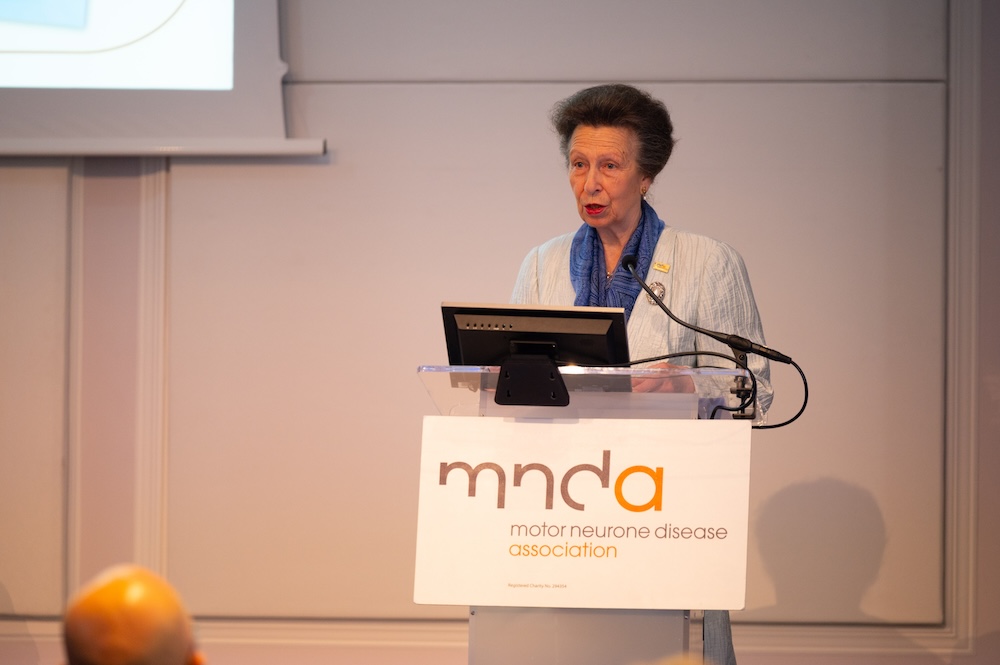
HRH the Princess Royal has underlined the importance of collaboration in the search for a motor neurone disease cure.
The royal was speaking at the MND Association’s Countdown to a Cure reception, held this week in London.
The event was an opportunity to reflect on the charity’s support for MND research and how some of its funding has resulted in significant progress in translational research.
This research, highlighted in its Countdown to a Cure report, aims to bridge the gap between laboratory-based research and the testing of potential treatments in people through clinical trials.

The Princess Royal was presented with a copy of the report and listened to a keynote speech from MND Association’s director of research development, Dr Brian Dickie MBE.
In her speech, she thanked everyone for their continued support of our ambition to find a cure for MND and highlighted the importance of collaboration and the need to move research from the laboratory into hospitals as quickly as possible.
Chief executive of the MND Association, Tanya Curry, said: “We were delighted and honoured that The Princess Royal, who has been our Royal Patron for the last 16 years, was able to join us and invited guests at this special event to hear more about the progress that’s being made in translational MND research – taking trials from the laboratory into clinics.
“This kind of occasion is an important reminder for all of us about the strides that science is making and the role the MND Association, as the leading charity funder of MND research in the UK, and our incredible supporters have in ensuring that continues.”
Dr Brian Dickie MBE, added: “It was a pleasure to engage with our guests face to face and thank them for their amazing support for our research programmes. Advances in technology and significant new discoveries are accelerating the pace of research, catalysing exciting new partnerships aiming to translate this new knowledge into potential treatments. Together, we share common ground to understand, treat and – ultimately – defeat MND.”
Catherine Mair, who has MND and attended the event with her husband Alan and their daughters Anna and Olivia, said: “It’s valuable to hear about projects the MND Association is supporting and progress so far.
“Like everyone affected by MND, knowing so much research and collaboration is going on gives us continued hope for effective treatments and a cure. I am well aware the cure may be too late for me. But I hold out hope for those similarly afflicted, or may be so, in the future.”
For more information about MND and the MND Association please visit www.mndassociation.org