




Patients with new spinal cord injuries (SCI) whose blood pressure is maintained within a newly-defined range during surgery may stand a better chance of regaining some mobility and functionality – even in patients with the most devastating injuries.
Using a novel machine-learning technique called topological data analysis (TDA), researchers at UC San Francisco were able to identify patterns in large datasets to find previously unknown connections that explain why some people recover some motor control after a significant injury, while others are left with total paralysis.
The study also may have ramifications for patients undergoing spinal surgeries for more common conditions, the researchers said, although further investigation is needed.
“Without the use of TDA, data would be heterogenous, overwhelming and beyond human comprehension,” said co-corresponding author Dr Adam Ferguson, director of data science at the UCSF Brain and Spinal Injury Center.
“Topological data analysis helped us to ‘see’ patterns that are difficult for humans to see,” he added.
Ferguson was the first scientist to harness machine learning as a tool to uncover the connection between spinal cord injury recovery and blood pressure, using data from both published and unpublished studies.
For one particular participant in the research, a father of two injured in a surfing accident, the innovative insight and bench-to-bedside research that followed meant the difference between total paralysis and resuming his life.

The study also may have ramifications for patients undergoing spinal surgeries for more common conditions, the researchers said, although further investigation is needed.
The study, which draws from retrospective data from hospital operating rooms, follows preclinical research by Dr Ferguson, using data from both published and unpublished studies.
In the current study, the researchers tracked data from 118 patients at two hospitals with Level 1 trauma centres: Zuckerberg San Francisco General Hospital and Trauma Center (ZSFG) and Santa Clara Valley Medical Center.
They compared the estimated grade of injury on admission with the estimated grade of injury at discharge.
Grades followed the American Spinal Injury Association Impairment Scale and ranged from A, denoting complete motor and sensory function loss below the level of injury, to E for normal sensation and full motor function.
The same machine-learning technique used by Ferguson with preclinical data in the earlier study was applied to the current study using clinical data collected at one-to-five-minute intervals while the patients were in the operating room.
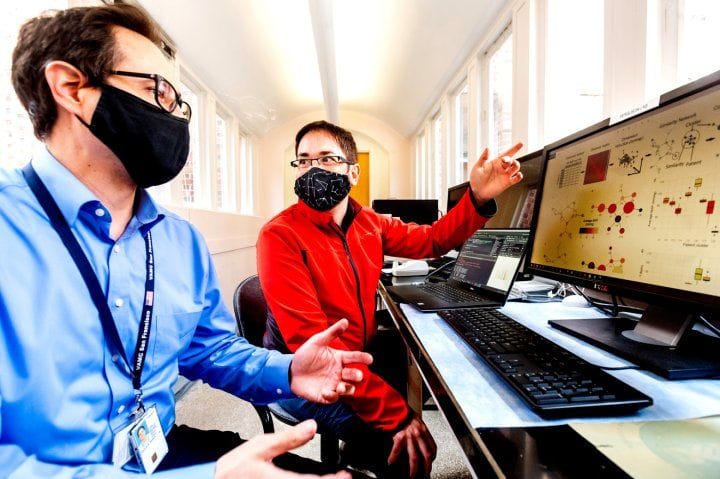
Dr Abel Torres Espin and Dr Adam Ferguson examine patient outcome data, visualised using machine learning
Of the 42 patients whose injuries had improved by at least one grade from admission to discharge, 18 had had a grade A injury, eight grade B, 11 grade C and five grade D.
These TDA patterns were then verified by spinal cord injury experts and statisticians, who developed rigorous statistical models that “assessed their truth,” Dr Ferguson said.
“This is an ideal use case for how machine learning could be implemented in biomedicine – it’s a partnership between machines and humans with clinical domain knowledge,” he said.
“In essence, we are machine learning-assisted cyborgs.”
Patients with blood pressure that was too high or too low during surgery had poorer neuromotor recovery after surgery, the researchers concluded.
Maximal recovery was associated with mean arterial blood pressure maintained between 76 mmHg and 104-117 mmHg, a range that is narrower than the current guidelines that have followed smaller clinical studies.
“Damage to neurons in spinal cord injuries leads to dysregulation of blood pressure, which in turn limits the supply of blood and oxygen to stressed spinal cord tissue, exacerbating spinal neuron death,” said co-lead author Dr Abel Torres-Espin, of the UCSF Department of Neurological Surgery and of the UCSF Weill Institute for Neurosciences.
“Thus, precise blood pressure management is a key target for spinal cord injury care.”
For patients with the most severe grade A injuries, optimal blood pressure during surgery may be a key factor in demoting those injuries to grade C, the researchers noted.


