Exoskeletons in neuro-rehab

Robotic exoskeletons provide an external frame with motors providing movement of the knee and hip joints, with various amounts of trunk support, to enable an individual to move in a simulated walking pattern, or exercise in different standing postures.
Research into the use of exoskeletons within neuro-rehabilitation has found them to be safe and well tolerated (Gorgey, 2018) whilst offering a range of physiological and therapeutic benefits to the patient. These include:
- Benefits to health and fitness
- Reduction in spasms (Miller et al., 2016)
- Improvement in bladder and bowel regime (Gorman et al., 2021)
- Improvements in cardiopulmonary health/ exercise tolerance (Hicks, 2021).
- Improvements / maintenance in bone density (Karelis et al., 2017)
- Maintenance of range of movement (White et al., 2015)
- Anecdotal improvements in neuropathic pain, musculoskeletal pain, sleep hygiene and trunk stability and balance in and out of an exoskeleton
- Benefits for psychological wellbeing
- Being at eye-level with others (Manns et al, 2019)
- Engagement with rehabilitation sessions (Chiș et al.,2020)
Whilst the bulk of researchers have explored the use of exoskeletons in patients with Spinal Cord Injuries, exoskeletons are not condition dependent and can benefit anybody with mobility difficulties, helping to increase the time spent on their feet with less fatigue, practising balance and strengthening exercises in standing and walking with motorised support, to either help improve what can be achieved without the exoskeleton, or provide a means of upright mobility for exercise and therapeutic walking.

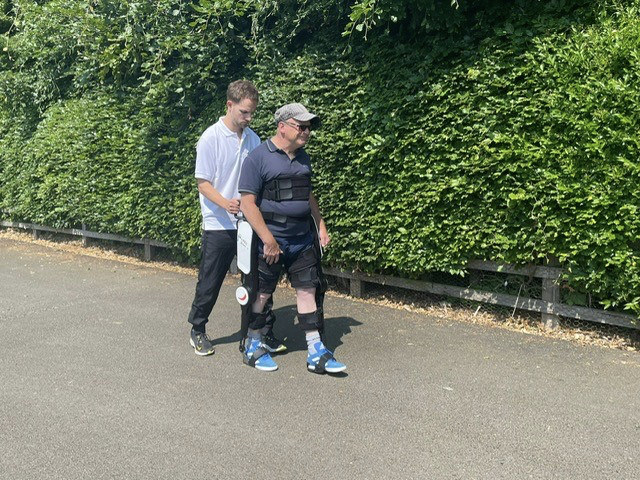
Last year the Rapper III trial that explored the use of the REX exoskeleton in people with MS, found that the device was feasible and safe to use with this population, and resulted in improvements in balance, joint mobility, spasticity and quality of life after just four, 45–60-minute sessions (Sakel et al., 2022).
There are currently 6 overground robotic exoskeletons available within clinical facilities in the UK. These are:
REX – Self-supporting exoskeleton operated by a joystick and allowing handsfree movement, as well as the completion of standing exercises such as squats and lunges.
ReWalk – Designed by a tetraplegic engineer with the intention of allowing independent upright mobility, this ‘passive’ (motors always active) exoskeleton requires the use of crutches to balance the user and can be used to walk in the community and climb up and down stairs.
FREEWalk – A rehabilitation exoskeleton from Taiwan that provides higher levels of trunk support, a half foot plate and abducting limbs for fitting, plus varied levels of motor assistance to allow user engagement and re-education. For independent use crutches are required to manage balance, but the device can be safely supported by a therapist to practice handsfree walking rehabilitation.
Indego – Lightweight and modular with the ability to reduce and deactivate individual motors of the hip or knee to provide a flexible and active gait rehabilitation tool. Again, requires the use of a walking aid for independent use in order to maintain balance.
Ekso – Arguably the cleverest exoskeleton with a gait pattern most similar to ‘natural’ walking, the Ekso is a rehabilitation exoskeleton offering very high levels of trunk support making it applicable for a wide range of patients. Constant real-time monitoring allows dynamic and adaptive assistance to be provided during the gait cycle. For independent use a walking aid is required but similar to FREEWalk it can be stabilised safely by a therapist for gait and balance retraining. Due to an extensive array of sensors the Ekso is only recommended for indoor clinical use.
ExoAtlet – New to the UK the Exoatlet combines many features of the aforementioned exoskeletons with high levels of trunk support, dynamic assistance, stair ascent and descent and also has a built in functional electrical stimulation unit to provided patterned stimulation of the muscles during walking.
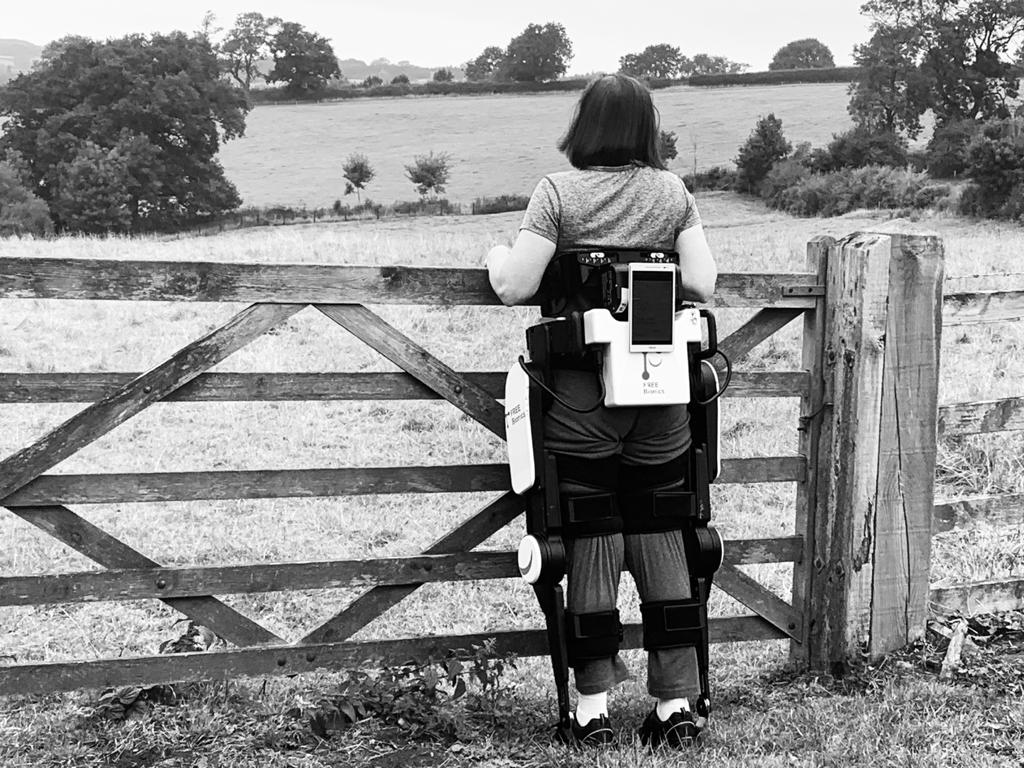
Physiofunction is one of few facilities in the country incorporating exoskeleton technology into our rehabilitation provision. We work with three of the six devices: the Rex, ReWalk and FREEWalk, which enable us to match the most appropriate device to the needs of our clients based upon their presentation and goals.
Much of our recent work with exoskeletons in our clinical population has involved working with individuals with acquired brain injury, stroke, primary ataxia, and Multiple Sclerosis. Goals of these sessions have been to facilitate supported standing in a well aligned posture, with equal weight bearing through both feet, and in particular when using the FREEWalk, allowing the forefoot to engage with the ground to help activate proprioceptive pathways in the nervous system. This is of even greater benefit when walking as the natural mechanics of the foot can be facilitated during the stance phase of gait, aiding in gait re-education and the restoration of independent walking. With the REX we can combine various standing postures with exercises such as tennis, throwing and catching, band resisted strengthening and even use virtual rehabilitation platforms such as the Mindmotion Go.
Exoskeleton therapy can be delivered both as a standalone treatment, and part of a larger rehabilitation programme, such as a component of our intensive packages or discharge continuity service.