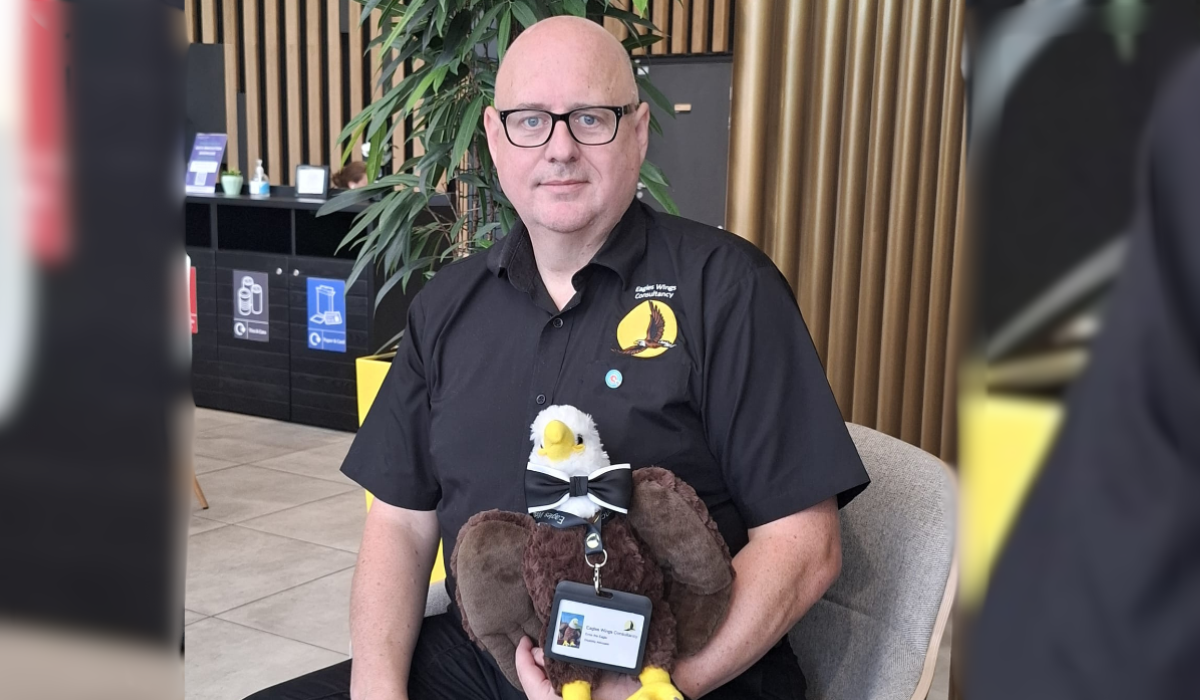
NR Times speaks to NR Times award-winner John McDonald, Disability Consultant at Eagles Wings Consultancy.
Winner of the Above and Beyond award sponsored by BIS Services, John’s mission is to promote inclusivity and diversity in the workplace.
Eagles Wings works with businesses create to a respectful and inclusive environment for all individuals, including those with neurological conditions and invisible disabilities.
Hi John. Please take us back to 2016 when this all began for you.
In 2016, I was diagnosed with bowel cancer and fluid on the brain.
When they tried to drain the fluid off the brain, they filled my head with air. I often tell people that I’m officially an airhead now!
I ended up being in non-intensive care, ventilated and my family being prepared for the worst.
It’s left me with a fatigue, balance and cognitive issues. When I’m fatigued, I struggle with my speech and so on.
As a result of that, I found staying in employment difficult. It was hard to get organisations to understand how to work with brain injury, fatigue and non-visible disabilities.
After a couple of years of bouncing in and out of employment, I realised that I could use my experience to help organisations engage with people with disabilities.
I started Eagles Wings Consultancy and since then, we’ve helped businesses understand and engage with disability in the workplace.
You’ve you mentioned fatigue. What are some other common issues that people with brain injuries in particular can face when they’re trying to get back to work?
It’s a really complex one, because everybody’s brain injury affects them in a different way.
Brain injury is an umbrella term that can cover a lot of things. Employers sometimes strugggle to understand the practical implications of the term.
It’s about finding that balance of what I actually need, as opposed to what people think I need and what perceptions of brain injury are.
I think they’re the biggest barriers, and I’ve worked hard to try to break down those barriers.
One of the things I do is a disability disclosure form, which quite clearly sets out my disability, here’s how it affects me, and my coping strategies.
If I hand that over in an interview, it empowers the interviewer, because they now know what I need.
It’s also good for me, because I’m not trying to second guess what questions they might ask me or waiting until the end of the interview to go ‘by the way…’
It’s all dealt with in the letter so now I can focus properly because I’m processing less so my cognitive functions are working better.
It must be quite difficult to to find that balance of wanting to advocate for your own needs, but at the same time worrying that it might work against you with an employer
Indeed. And I’m trying to get most employers to work from two questions: ‘How does your disability affect you?’ and ‘what support you need from me?’
When we get the answer to those two questions, I can build adaptations, I can build a policy, I can build awareness phasing if need be.
What role does ongoing training and education play in ensuring that a workplace is a supportive environment?
You can have all the policies and procedures in place, but if the culture is not right, then they’re not implemented effectively.
It’s important to make sure that the culture has that inclusive, adaptive mindset, making sure that people understand when adaptations have been asked for, what their purpose is, and why they’re not a burden.
It’s not about somebody wanting a nicer computer and somebody else. It’s because there’s a genuine need there, and meeting that need helps the organisations become more adaptive as well.
I guess thats a win-win for those organisations, because the more accessible they become, the more open they are to welcoming people who could be really valuable to their organisations.
Indeed. And it’s one of those that has such a huge like the knock-on effect on everything.
If someone with a brain injury can stay in employment, that means they’re not claiming off benefits, which means that their mental health improves, which means there’s less draw on the whole system, and then they can move forward.
They then become the best advocate for your company, because they like working for you. So it is a very much a win-win.
What advice would you give to employees with brain injuries who are struggling to advocate for themselves at work?
I would say to look out for support groups. Things like Headway, where you can find other people who are in similar situations.
Look to Access to Work, where you can get support. I know the paperwork can be quite traumatic. But I went to an agency called This is Me who did all the paperwork for me.
Also look towards the friends and family who are going to support you on your journey.
I’ve had to do a lot of listening to find out who I am, how I am and how I function.
When I understand how I function, I can put my coping strategies in place.
That’s all part of the process: understanding where you are, what you can do and how you can overcome barriers.
When you understand that, you can go to an employer again with a solution focus.
Yes, I’ve got balance issues, but all I need is a reasonable chair. Easy enough done.
And because I’ve come with the solution, employers engage better. It’s not like you’ve gone there with a problem and told them that they have to fix it.
What have you got coming up this year?
I’d really like to hold a conference that brings the disability and employment sectors together.
This has been turning away in the background for a while and I’m starting to get a lot of interest from people who want to get on board.
We would all sit in the room and look at what x policy says and consider that against what we actually need so that we can become known as an inclusive region.
That sits within my bigger project of having cities of inclusivity and making the whole city more accessible.
Things like not having music blaring in shops, which is difficult if you have cognitive and balance issues.
That makes us more inclusive and then that means I can engage in the local economy, making it a more inclusive culture within the whole city.
We’re also going to continue to work with organisations who are interested in making change.
I always say to people: Are you willing to make change? And can you make change?
If that’s a yes, let’s have a cup of tea and a chat.