




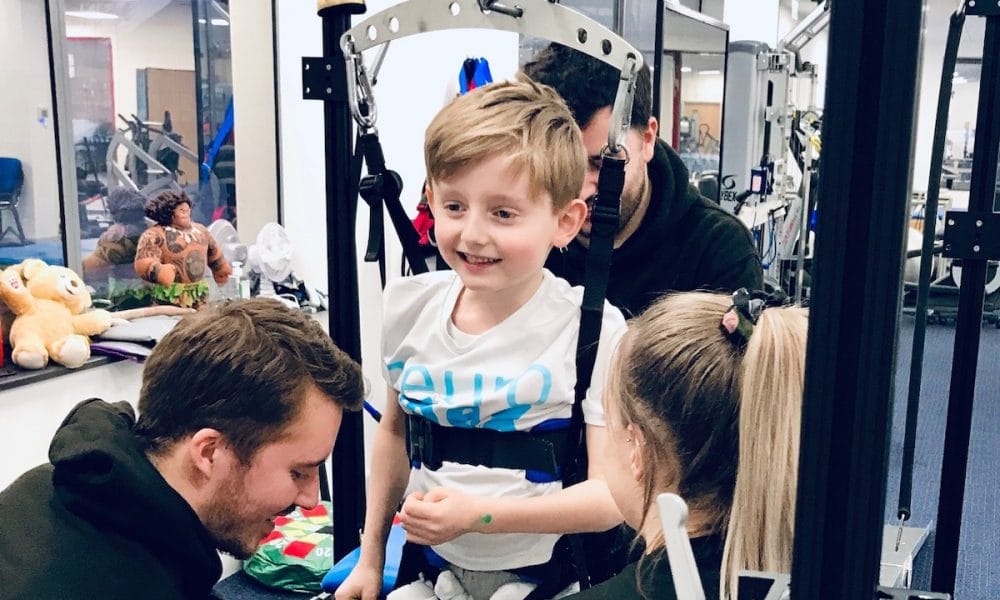
Many individuals living with spinal cord injury, regardless of time elapsed since their injury or their age, experience improvements with posture, walking, health and well-being after receiving Locomotor Training. So, what is it?

Locomotor Training is a rehabilitation intervention that is driven by the main goal of recovering function. It is based on our current knowledge of how the brain and spinal cord control stepping and how the nervous system learns motor skills. Ultimately, we are training people living with paralysis to stand, step and walk again. The benefits from this restorative approach reach far beyond its ultimate goal. Cardiovascular and pulmonary function, increased bone density, reduced spasticity, decreased skin lesions and greater ability to tolerate glucose are a few of the life-enhancing outcomes often attributed to this intervention.
How does it work?
Firstly, it’s important to understand the mechanisms of locomotor training. It provides activation of the neuromuscular system below the level of lesion with the goal of retraining the nervous system to recover specific motor tasks such as those required for posture and mobility. It’s best when delivered in a systematic and standardised way such as the approach used by Neurokinex and our affiliated NeuroRecovery Network centres.
 Approaches should be protocol driven, encapsulating the essential ethos of this intervention, and ensuring that each and every individual who participates in locomotor training receives access to the same evidenced-based standards of practice. Locomotor training appears in-sync with the current curve of scientific evidence in the field of neuro-recovery as the approach utilises a workload of highly repetitive movements such as stepping. This has been shown in both human and animal studies of movement to have the best functional recovery outcomes.
How is it delivered to individuals living with paralysis?
Locomotor training delivery is in three functionally linked components.
Step training: The principle of this phase is to help an individual’s nervous system to relearn the motor patterns associated with walking.
Generally, it is delivered with participants using body weight support systems suspended over a treadmill. Specially trained therapists deliver repetitive sensory specific movement cues to an individual’s trunk and lower limbs stimulating a repetitive impulse to the spinal cord while simulating walking in a correct posture at an age-appropriate speed.
Overground walking: This phase challenges the individual’s nervous system to be able to adapt and cope with an overground environment.
It utilises the same approaches mentioned above but takes an individual through different challenges such as they may encounter in the real world or off the treadmill and addresses any gait deviations.
Community ambulation: This phase is the last phase of the programme where it meets life goals.
Community ambulation which is at a safe level of independence, in a home and wider external community setting.
Here at Neurokinex we have seen some extraordinary gains for clients aged four to 75. Locomotor training is high on most clients’ lists treatment techniques they wish to explore. The vast majority will have this opportunity and we have seen some outstanding improvements and results. Quite simply, the potential of Locomotor Training to expedite recovery in individuals living with spinal cord injury makes it an exciting prospect.


