Linked robotic exoskeletons could improve stroke gait training by allowing therapists and patients to influence each other’s movements in real time, new research suggests
The system links two wearable robotic devices, allowing a therapist to guide a patient’s hip and knee movements using their own legs.
In evaluations involving eight stroke survivors, participants showed greater joint range of motion and took longer, higher steps than during conventional therapist-guided treadmill training.

The system was developed by researchers at Northwestern University in Evanston, Illinois, and the Shirley Ryan AbilityLab hospital in Chicago.
Lorenzo Vianello, a researcher at Shirley Ryan AbilityLab and co-first author of the research, said: “By combining the hands-on adaptability of physical therapy with the scalability and precision of robotic systems, it can enable more comprehensive, whole-body gait training without requiring multiple therapists, while also introducing real-time responsiveness to patient performance, allowing support, resistance and feedback to be adjusted dynamically.”
Many people need to relearn how to walk after a stroke because leg weakness, poor coordination and reduced control can make movement difficult.
Conventional physiotherapy often requires therapists to provide physical support and correct individual parts of a person’s walking pattern. Several therapists may be needed to train the whole body.
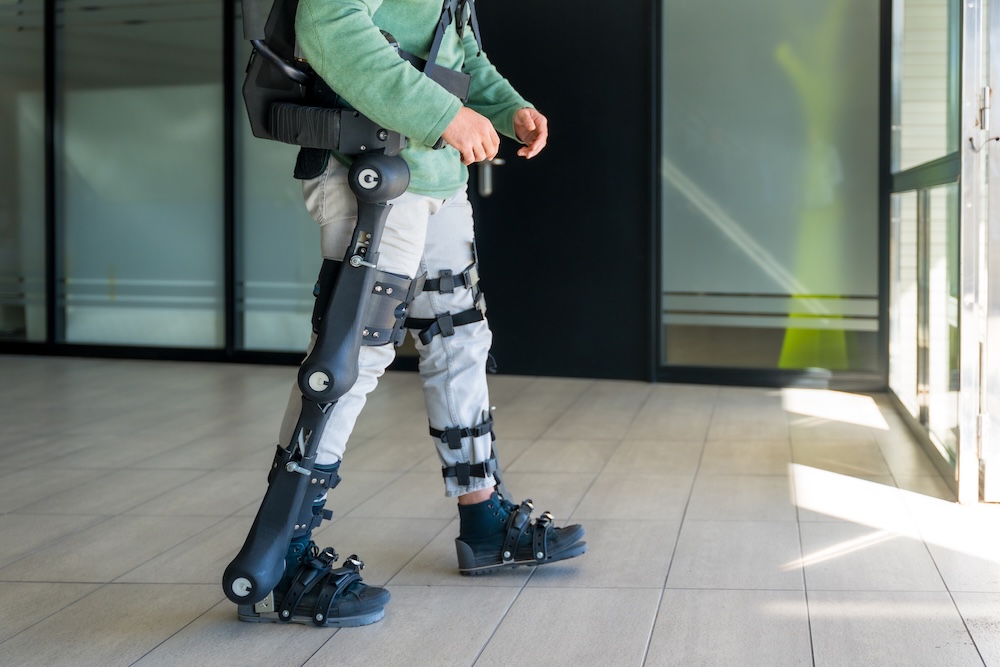
Robotic exoskeletons are wearable devices that support or move a person’s limbs. They can allow people to practise walking for longer, but many follow fixed movement patterns that do not fully adapt to their performance in real time.
The new system, known as therapist-exoskeleton-patient interaction, or Tepi, uses two lower-limb exoskeletons.
The therapist wears one device and the patient wears the other. Software virtually links them at the hips and knees, behaving like a combination of springs and shock absorbers.
This allows each person’s movements to affect the other’s in real time, while support, resistance and feedback can be adjusted dynamically.
The researchers said therapists could use the system to provide more personalised rehabilitation as patients work towards their recovery goals.
Participants using Tepi showed similar levels of muscle activation to those receiving conventional therapist-guided treadmill training.
They also reported high levels of motivation and enjoyment.
Emek Barış Küçüktabak, another co-first author who completed the work while a graduate research assistant, said: “By allowing therapists to guide a patient’s movements through their own leg movements, Tepi could provide an impactful complement to conventional gait training for stroke rehabilitation, reducing physical effort that can contribute to fatigue and injury for therapists during hands-on therapy.”
The researchers now plan to examine whether the system could be used for activities such as climbing stairs, standing up and sitting down.
Matthew R Short, a co-first author and postdoctoral researcher at the University of Delaware, said: “Future work will also investigate more accessible and scalable systems that can extend therapist-guided rehabilitation into the home and support remote care.”