Charity launches nationwide fundraising appeal for psychiatric patients

The UK’s largest mental health charity specialising in complex mental health, located in Northampton, has launched a major fundraising appeal designed to support psychiatric patients.
Founded in 1838, For Hope in Every Life is St Andrew’s Healthcare’s first fundraising appeal for more than a century.
Complex mental health affects us all.
One in 105 people have a diagnosis for a severe mental health condition (SMI)*, meaning that we are likely to know someone in our lives.
Putting this another way, that’s more than the population of Edinburgh.
While society has come a long way in recognising mental health and breaking taboos, the most vulnerable – those with the most complex needs – are often overlooked.
This is where St Andrew’s Healthcare and For Hope in Every Life steps in.
Dr Vivienne McVey, Chief Executive Officer of St Andrew’s Healthcare, said: “For Hope in Every Life is hugely ambitious.
“We want to help transform the lives of thousands of people who are often overlooked in our society.
“We want to support them to find a sense of self, connect with their community and live a better life. It’s about rediscovering hope for every life.”
Oli Hiscoe, Head of Fundraising at St Andrew’s Healthcare, said: “For Hope in Every Life bridges the gap between what quality care provided and going the extra mile to make the difference for patients.
“By combining innovation, compassion, and evidence-based approaches, we strive to revolutionise complex mental health care and show what is possible when we go over and above for our patients.”
There are several ways to get involved.
Individuals can donate or embark on inspiring fundraising challenges.
Companies, schools and community groups can partner with St Andrew’s to raise funds and have a real impact and can join a group of dedicated volunteers to support patients across the country.
To get involved and be inspired go to hopeineverylife.org
Donors, partners and volunteers can choose how they want money raised to be spent.
This could be therapeutic garden programmes, musical workshops, exercise-based initiatives, enhanced aftercare, specialist research into complex mental health, or many other ideas.
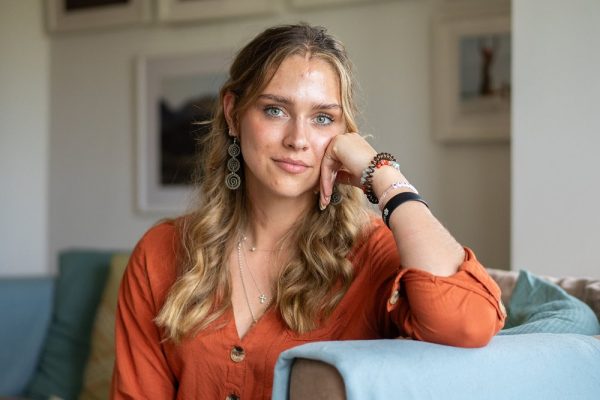
Sedona
Sedona was a patient at St Andrew’s Healthcare for two-and-a -half years and before her admission she had been in multiple different hospitals.
She has struggled with her mental health since the age of 15 and has been diagnosed with anorexia nervosa and borderline personality disorder.
Sedona said: “My risk level was very high and I was self-harming a lot.
“I was attempting suicide a lot and before I came to St Andrew’s, I was ending up in intensive care units on the operating table pretty regularly.
“The extreme risk of my suicide attempts meant that the longer that went on for, the closer I was going to be to death.
“All those people that were treating me in the hospital following these incidents, were pretty sure it was going to result in death as well.”
It was not until she was admitted to a personality disorder specific ward at St Andrew’s in 2021 that she felt that her mental health started to improve.
She said: “For me, being on a ward that was specialised to treat my complex mental health condition, meant I could get purely targeted treatment and I received therapies that are proven to help with the disorder.
2I felt like I was being treated like a human again, and there was that tiny bit of hope that kind of popped up.
“There was such a structured approach from a multidisciplinary team that was able to give not only me, but the other patients as well, a very clear structured pathway in order to get back into the real world.
“St Andrew’s was different to other hospitals I had been in, because there were so many extra occupational activities available.”
During her inpatient stay Sedona was given access to music lessons, where she learnt to play the cello, she took her A Levels and even passed her lifeguard qualification.
She said that having staff believe in her “finally felt that someone was giving me a way out as long as I committed to my recovery”.
Sefona was discharged from St Andrew’s in 2023, and was moved into a supported accommodation.
There she managed to stay well and has now started studying bio-medicine at Bath University.
She said: “I genuinely never believed that I would get to this stage in my life, and I think a lot of the professionals who worked with me didn’t expect me to get this far either.
“For a long time, everyone – including myself and my family – were convinced my behaviour was going to end in death. Certainly at the time, I didn’t want to live and I didn’t think I had a future.
“But now I am building my own life for myself. I’m living by myself. I’m going to university.
“I’m doing all these things that I never thought I’d be able to do.
“Hope is what got me through those last few years in hospital, because all the staff around me were so hopeful.
“It’s only because the people around me gave me hope, that I started having it too. St Andrew’s changed my life.
“The staff at St Andrew’s were incredibly supportive towards me which is why I jumped at the chance to be involved in the For Hope In Every Life appeal – because they taught me – my life is worth living.
“And I’m so grateful for that because now I’m at university, I have a boyfriend and I have a future. I can absolutely say that if it wasn’t for this hospital, I would not be here.”
*Data was published by the Department of Health and Social Care/Public Health England which reported SMI figures