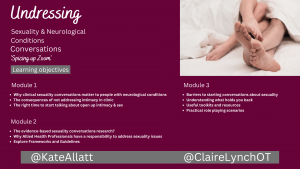
Sex and Neurological conditions can be a tough subject for health professionals to conquer, however, this new course aims address this issue head on.
Dr Kate Allatt made a remarkable recovery from Locked in Syndrome, that came as a result of a stroke.
Kate was only 39-years-old when she suffered from stroke in 2010.
Since then, she has become an internationally published author, award winning stroke disrupter and charity founder.
Kate has spent over 12 years campaigning on a variety of younger stroke issues.
However, it was during lockdown that she experienced how important conversations of sexuality are.
After Kate had gone through a divorce, she recalls her experiences as being a ‘drop in the ocean’ compared to those expressed by her lonely stroke community.
This inspired Kate to discover a route to make a difference, in order to support other disabled individuals to be able to enjoy intimate and loving relationships.
She sought out a partnership with someone who shared the same passion, to equip health professionals with the tools they need in order to have what can often be seen as difficult conversations on sexuality, with service users at home and in their clinic.
This is when she met Dr Claire Lynch.
Claire is a lecturer in Occupational Therapy at the Australian Catholic University. She completed her Professional Doctorate in Occupational Therapy with a research focus on exploring sexuality from an occupational perspective.
After completing her PhD, Claire has since extended her research to focus on the importance of sexuality to various consumer groups as well as exploring how healthcare professionals can address sexuality with confidence and comfort.
The two share similar philosophy in wanting to make an impact in this previously untouched area of practice and to ultimately allow all individuals across the lifespan to live life to the fullest.
They believe that too many diverse service users are abandoned in the community without being able to enjoy intimacy in their lives, due to health professionals “being embarrassed, making judgements, being too busy, assume it’s someone else’s job or are unconfident and ill-equipped to start conversations about sexuality at home or in clinic.”
“Intimacy and sex is a basic human right and daily living activity.”
Kate and Claire state that it is their mission to get healthcare professionals confidently discussing sexuality at home, or in the clinic.
“We want those intimacy conversations to become as normal as discussing where to put up hand rails in service users homes.”