Neil Russell has gained a reputation for his passionate defence of the care sector and his efforts to secure greater recognition of the vital role the staff working within it play in healthcare.
Here, he speaks to NR Times about why he’s proud to be outspoken and how his specialist neuro care company PJ Care is leading sector-wide change
For many years, the crisis around care and its reputation has been increasing, amplified significantly by the COVID-19 pandemic and the perceived lack of recognition for the role frontline care workers played during some of the most challenging conditions most had ever encountered.
Regarded by many as being an underpaid and under-valued profession, the estimated shortfall of 80,000 care workers is putting the sector under immense pressure to continue to deliver the often life-changing specialist care so many people depend on.
This is not lost on Neil Russell, chairman of PJ Care, who has become a vocal and outspoken critic of the challenges facing social care, a champion of the need for greater recognition, and is helping to pave the way for change through his own business.
With continued investment in the development of the PJ Care frontline team, who are paid the real living wage, Neil is targeting an hourly rate of £15 per hour within the next four years for his staff, in recognition of the huge role they play in healthcare.
The business – set to significantly expand one of its three care centres in the near future – is also addressing the recruitment crisis through its apprenticeship programme, with PJ Care now having one of the biggest percentages of apprentices among its staff in the sector, and carers now beginning to qualify as nurses as a result of their in-house training.
PJ Care, which has 183 beds across two purpose-built centres in Milton Keynes and one in Peterborough, is also helping to address the future of care and the valuable role of technology within that by embarking on a pioneering research study with the University of Leicester.
Neil – who proudly confesses to having done every job within PJ Care, from maintenance man to carer – acknowledges that his change-making approach isn’t welcomed by everyone, but in a sector where action is urgently needed, he is determined to make that happen.
“Yes, I’m opinionated. But it can actually be really useful because then it raises the profile of the social care sector,” he tells NR Times.
“It’s like Steven Bartlett from Dragon’s Den once said on his podcast – if you walk into a bar and there’s somebody dancing on the table, 50 per cent of the people in there are going to hate that guy, but 50 per cent of the room like it.
“If you want to make a difference, you’ve got to be the guy dancing on the table, because eventually other people are going to get up and dance with you.
“And that’s what we were doing, to a degree, we are dancing on the tables, making a spectacle of ourselves. A lot of people don’t like it. But a lot of others do.”
And for those who do, Neil is a breath of fresh air, a champion of change who frequently challenges the issues so many do not. In characteristic style, Neil is matter-of-fact about why social care deserves more appreciation.
“There are 200,000 nursing care beds in the adult social care sector, but only 100,000 NHS hospital beds in England. So we were clearly doing something useful to the NHS by keeping those 200,000 people out of those 100,000 hospital beds,” he says.
“We’re cheaper than a hospital bed, and when it comes to the long-term care we provide, we’re better at it.
“But because we’re in the main privately owned, there’s an awful lot of people think that’s a bad thing. We make a profit – but we have to make a profit because we’re privately owned. It’s actually a legal requirement. If I operated at a loss, I’d end up going to jail.
“Some people still see us as kind of bad guys because that profit word is involved. It’s a challenge to try to overcome that.
“But because I have done every role at some point, I’ve done personal care and managed challenging behaviours, I’ve mopped the floors and cleaned the toilets, I know the work our team do – and that’s why I’ll always stand up for them.
“It’s these guys who are on the frontline, the carers, the nurses, the housekeepers, the chefs. I’m sat at home now staring out over rolling fields out of my window, and it’s not right for me to take the plaudits. I’m not the one who’s actually doing the work. But I can help to make a difference.”

While Neil regularly speaks out on issues affecting the sector – as well as his many and regular media appearances, he was quoted in the House of Lords over his opposition to mandatory vaccinations for care staff – he is also keen to lead the way with PJ Care.
Founded in 2000 by his mother, Jan Flawn – awarded a CBE for her nationally-significant work during a long career in healthcare – and opening its first neurological care home the following year, the company has become renowned for its high standards, both for clients and staff.
Named as a Sunday Times Best 100 Employer with a Platinum Investors in People Award, PJ Care also delivers strong outcomes for people with neurological injuries and progressive conditions, often after failed placements elsewhere.
The quality being delivered – planned intricately by Jan ahead of the opening of Bluebirds in 2001, and replicated in the subsequent openings of its Mallard and Eagle Wood care centres – is all-important to the business.
“The Bluebird and Mallard are both record-breaking vehicles, and we chose those names to reflect that we’re pushing the boundaries of excellence,” says Neil, who was working as a Foreign Office press officer in Poland when PJ Care was established, and relocated back to the UK to join his mother in the business.
“We have some fantastic success stories, there have been so many over the years. There was one gentleman with frontotemporal dementia who hadn’t spoken for two years. He was a former nurse and within six months of being with us, he was doing the drugs rounds with our nurse and telling her what she should be doing.
“There was another guy who came to us for six weeks of palliative care – he had 18 months because he was in the right place.
“In an environment where people feel safe, they can achieve so much. That’s what we want to give them. Watching people walk out of the front door, after you’ve supported them to do that, is what it’s all about.
“And for our staff, it’s things like paying the real living wage instead of minimum wage, and we’re working to push that up as high as possible.
“We’re aiming over the next three or four years to hit £15 an hour as the starting rate. We have a lot of work to do in order to do that, so we’ll be able to afford to pay for it, but the advantage we have is that no one else owns our business. It’s all family owned.
“That’s a big part in us being able to take the stance we do, to speak out like we do.
“We’ve got 100 per cent occupancy. We’re not tied in to local authority rates or CCG rates, every resident has got a separately negotiated contract. We haven’t got external investors who want their their 10 per cent return before anything else is even considered.
“So we’re in a very fortunate position – but it’s our choices over the years that have put us in this position.”
The ongoing development of staff is something Neil is keen to focus on, to continue to grow PJ Care’s offering while also helping to address the wider recruitment crisis in the sector.
“We figured if we can get the skill levels up, so we’re building that up over time, we will improve the retention,” says Neil.
“We’ve got a huge training budget and our own in-house training team. We’ve got one of the country’s highest percentages of apprenticeships running, and carers who have been on our programme are now starting to qualify as nurses. There has been a shortage of nurses for years, so we decided to breed our own.
“But this is a difficult sector to work in. We’re getting a lot of people new to the industry, they come to us from retail or hospitality, and then they realise they don’t like it. But they don’t know that until they’ve done it.
“So you’re left to deal with that churn in the first few months as people come in and leave, but you have to give them a chance – some of our best carers never worked in care before they came to us.”
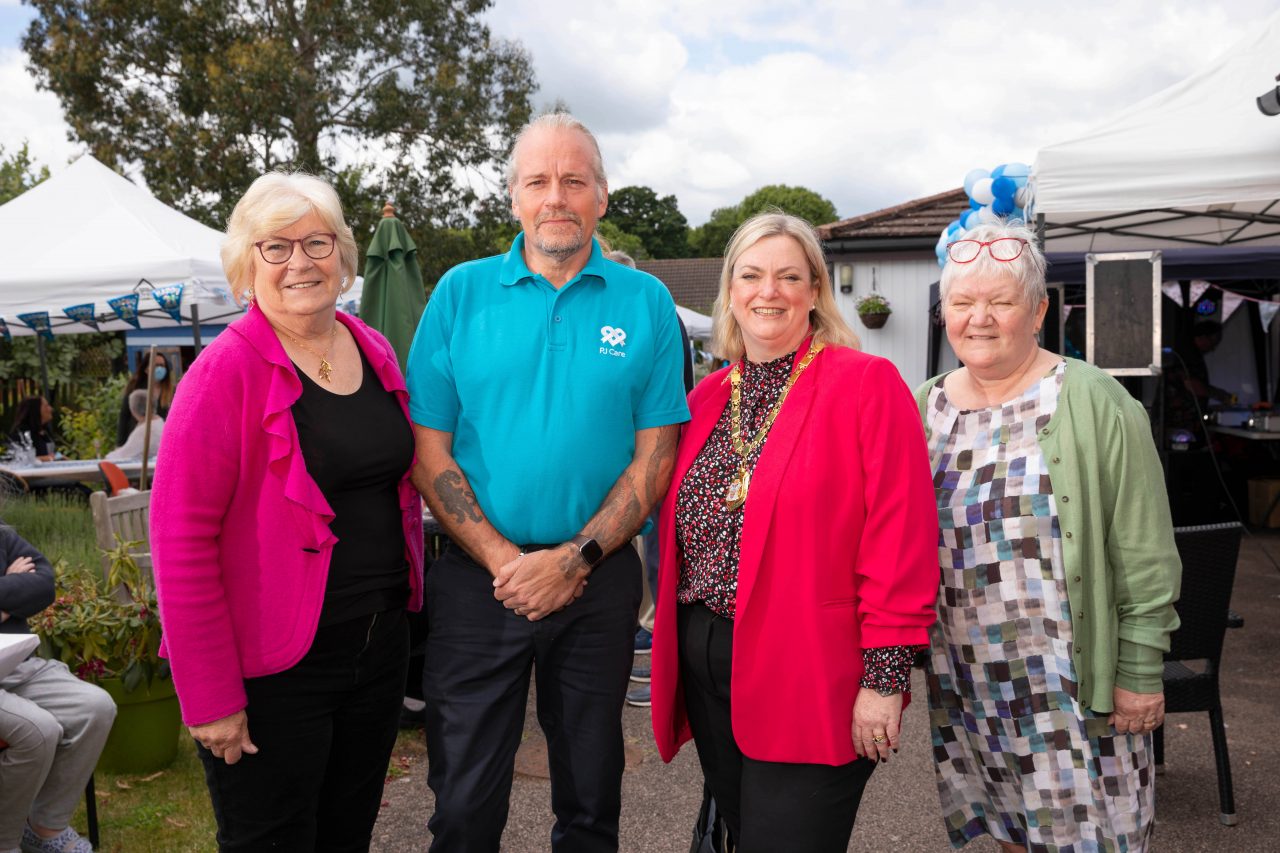
l-r Jan Flawn CBE, Neil Russell, Milton Keynes Mayor Amanda Marlow and manager of Bluebirds Colleen Brothers
Through Neil’s own background in working in all aspects of the care operation, not only does that give him a greater appreciation of the efforts of frontline staff, but also enables him to build the quality at PJ Care further. Two of Neil’s fellow directors have also worked in frontline care, and Jan – now a non-executive director – began her career in nursing.
“When I first came to join PJ Care, I had never worked in care, but my mum said not to worry because I’d only be working in the back office,” recalls Neil.
“Like that happened! Within three days of the first resident arriving, I was doing personal care.
“I’ve done every role there is, which has given me an appreciation of what the guys on the floor are doing and what they’re experiencing, particularly with this client group, because they can be incredibly challenging.
“When I visit the homes, although that has been restricted for the last couple of years, I will engage with the residents and assist with meal times. Some of the new staff can get a bit fidgety at me getting involved, but then they realise ‘Oh, actually, he can do this’.
“I have a simple rule now when I’m employing somebody, because I’ve done every job in the company. I’m a generalist, and I can do pretty much everything. But when are we employing someone who’s doing that job alone, I expect them to be better than I would be.
“I think that makes a big difference, so we make sure we get the best, and that’s why we get the quality we have.”
And that commitment to quality is continuing through PJ Care’s ongoing investment in its people, services and facilities.
A multi-million pound, three-storey extension is planned for PJ Care’s existing 105-bed Eagle Wood care centre in Peterborough, named Richard Hicken House in tribute to Eagle Wood’s head chef of nine years who passed away in 2020.
And keen to remain at the forefront of developments in care, the business is part of a pioneering study into how people can be supported through the use of technology, particularly through AI, and the positive impact that can make in their lives.
“We are committed to investing in the business and making it the best it can be,” says Neil.
“It’s interesting when we meet with the bank and they say ‘Your EBITDA is low’ and I’ll say ‘But it’s as high as it needs to be’.
“We pay everything we need to pay, and if we’ve got any more, we’ll put that back into the business. Of course I could buy a nice house in the south of France that I’m going to visit once a year, but that’s a bit of a waste.
“So we keep the EBITDA low and put it back into the business. They might not get it at first, but it only takes me a few hours of talking to the banks and showing them what we do before they go ‘OK, I get it’.
“You meet directors and senior managers from other companies, they’ve got their equity houses squeezing them because they’re not making enough profit, meaning they have to cut the amount of staff they’re paying, but then can’t provide the care they need to provide.
“For the smaller independent operators, they haven’t had the opportunity for the kind of structure my mum was able to put in place.
“In both situations, it can be very, very difficult – but for us, and others like us, we are in a stronger position.
“For us, we’ll keep pushing the boundaries of excellence, improving what we do and showing everybody else how to improve too, if they choose to follow.
“That’s it, really. That’s what we’re about.”