‘Feeling believed’ establishes the patient partnership to realise gains in FND care

By Nick Williamson, Neurophysiotherapist at PJ Care
The road to diagnosis of functional neurological disorder (FND) can be long and frustrating, and people may endure years of symptoms that have no apparent cause before they have a name for their condition.
Knowledge of FND in the medical community is still developing and awareness is even lower among friends, family and a person’s community.
People can be told they are ‘making it up’ or there’s ‘nothing wrong with them’, and this only adds to the psychological weight they are already carrying.

Eilish attended PJ Care in January 2025, as the first client of our FND outpatient service and she had already experienced the doubts regarding validity of her symptoms.
Eilish had lived with complex PTSD for more than 10 years but then in 2024 she began to have physical symptoms that started with a weakness/heaviness in her left leg and a facial droop.
The following day this feeling progressed to her right leg and while waiting in the surgery to see her GP, she had a dissociative seizure.
The initial diagnosis was a stroke, but this was changed to an Aura Migraine.
It took several weeks before Eilish could see a neurologist, by which time she was also struggling with memory loss, tremors, was using a wheelchair and the diagnosis of FND was made.
A Basis of Trust
When seen at PJ Care, Eilish was walking with a single stick but her gait was slow and hesitant.
The initial meeting was crucial for setting the tone of her care.
Eilish said: “They immediately made me feel safe and believed, as some people, including medical professionals, can make you feel as though you’re putting it on because there’s no obvious cause for what’s happening to you.”
With the first physiotherapy session with Eilish, we set the groundwork and agreed on short term goals that we’d work towards.
Eilish was very hesitant and apprehensive but I was honest with her – explaining that she would not like some of the activities, however she needed to try them so that we could establish a baseline.
In physiotherapy, it is vital with any person who has a diagnosis of Functional Neurological Disorder (FND) to assess, re-assess and then assess again (possibly more so than any other condition).
It is crucial to discuss findings, thoughts and interpretations with the patient.
The physiotherapist must not fix on the diagnosis but needs to “treat the person” and base the treatment on the findings of assessment.
The findings of assessment, not the diagnosis, will drive the rehab process. I explained to Eilish that each session we had would be an evolving process as I evaluated her abilities and her responses.
Setting Goals
Eilish presented with a diagnosis of FND and, through continual, evolving assessment and analysis I was able to discuss my objective findings and my analysis of how this was affecting her – in terms of her physical ability, her perception of her ability and how her body was working.
This process helped Eilish in validating her presentation and enabling her to progress in the knowledge that she had the support and belief of the Therapy Team.
Treatment of FND is unlikely to be successful unless it is driven by the person affected.
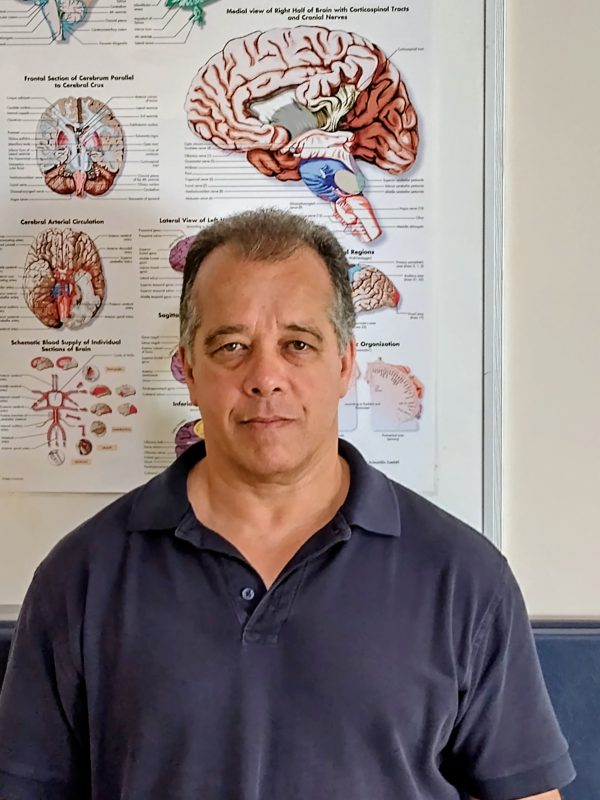
Nick Williamson
As a therapy team, we need to find out what that person wants to achieve. This process builds motivation and gives them a sense of self-determination.
Eilish wanted to walk, but more specifically, she wanted to be able to go sight-seeing on a much longed-for holiday to Sri Lanka that she and her husband had booked.
Input from Estefania Triguero, our Consultant Neuro Clinical Psychologist, was vital in Eilish’s rehabilitation.
Eilish had weekly physiotherapy and psychology sessions, and her attendance at the FND service was organised so that her psychology sessions would precede each physiotherapy session.
Estefania began each twice-weekly session with Eilish using mindfulness and relaxation techniques, getting Eilish to ‘check-in’ with her body.
Rather than trying to push feelings away the approach was to acknowledge them, to experience how they feel.
Eilish describes how, physically and psychologically, she was “in flight or fight mode” and recognising how every part of her felt – in an environment in which she felt safe – allowed her to consider what she could achieve in spite of those feelings.
Practising the everyday
My approach in the initial stage was to build her confidence.
When your body starts to betray you, you lose belief in its ability, and Eilish had a constant fear that she would fall.
To address this fear, we started by getting Eilish to allow herself to fall! Of course, this was a risk-assessed, controlled session and we started with Eilish kneeling on a mat.
I was always ready to catch her if the need arose but she had to allow herself to fall forward and then, at the last second, put out her hands to save herself.
As an outpatient, Eilish came to PJ Care only twice a week, and, because repetition was key to building her confidence, I sent her home with ‘homework’ to practice the activities by herself.
Eilish said: “I did this every day and, eventually, under Nick’s direction, I was able to do it with my eyes closed.”
With our strong support we were able to reassure and motivate Eilish and enable her to accept exercises, activities and challenges that she had previously considered too difficult or even impossible.
Eilish used to be a vivacious, outgoing person but she’d stopped working and didn’t want to go out anymore.
Her appearance had always been important to her so one of the tasks Estefania built into her programme was putting her mascara on.
Eilish said at first it felt “silly” but she dutifully did it every day.
Estefania had decided on this activity to develop the motor skills to use the make-up accurately and re-establish the communication between her brain and her body through repetitive tasks.
But it was also about building her sense of self-worth. She needed to feel that she was deserving of the effort.
Everything we tasked her with, Eilish gave 100 per cent.
Her progress was swift, although not without frustrated tears and a few expletives, and within a week or so she was walking indoors without the stick she’d relied on for months.
We’d helped her to realise that if she did fall over, she would be able to protect herself.
Jumping for joy – and more work
Continual assessment and analysis over a number of sessions revealed subtle motor issues that validated Eilish’s perceived problems.
Her confidence grew and we introduced more challenging activities.
Eilish was invested in exploring the causes of how her body felt and she and I together raised the expectations both in the physiotherapy sessions and the activities carried out at home.
Physiotherapy activities progressed from “falling forward” to jumping up onto a step and then progressing to jumping down from the step.
This was a major milestone for Eilish who, at the beginning of the programme, had been going upstairs on her hands and knees and coming down on her bottom.
She at first thought the expectation of getting her to jump was “madness” and there was no way she could do it but she now had the confidence to try. And she did it.
There was also a lot of “technical work” where we explored how Eilish’s body related to her environment – and the effect this had on her (including her fear of moving).
Eilish needed to relearn how her body felt in different positions and how to move from one position to another.
At one point I asked her how she felt physically while she was walking and she replied that it felt as though her left leg were “juddering”.
My response was to confirm to her that there WAS a judder/tremor of her left leg (I could see it and I could feel it) but
I said she had to accept what she felt and not let herself be intimidated by it.
Eilish had to accept that her body felt different to how it was prior to the start of her FND symptoms and not fight it or be apprehensive about it.
The technical work (where we broke down movements and focussed on specific elements) and the more dynamic physical activities propelled Eilish to the position where she was walking long distances outdoors (without the stick) including in low-light conditions – to further promote her postural competence.
Over the weeks Eilish improved both physically and psychologically, her muscle tremors reduced and she was guided to join a local gym and enrol in classes.
Summary
Eilish was discharged from our FND service after some six weeks of treatment.
We had a telephone follow-up after a few weeks and Eilish reported that things were still going well and she had continued with the gym classes, which she enjoys although, contrary to advice, she pushed herself so hard in the first gym session that she felt as if she were going to be sick!
She described herself as “being lost” and “not knowing who I was anymore” but after working with us, that’s changed and she feels she has “regained herself”.
Eilish was able to go on holiday to Sri Lanka and although she couldn’t do as much sight-seeing as she wanted to, she still fulfilled her dream.