


Tech & industry

When it comes to treating a stroke, timing is key. The quicker a stroke patient is treated, the more likely they will have better outcomes. This means that any intervention that can be made in order to speed up the process of diagnosing a stroke patient is highly sought after. Upfront Diagnostics, based in Cambridge, [...]
Researchers from Liverpool John Moores University have developed technology that can diagnose atrial fibrillation through the use of shopping trolleys. Professor Ian Jones, says: “This study shows the potential of taking health checks to the masses without disrupting daily routines. “Over the course of two months, we identified 39 patients who were unaware that they [...]
Researchers at the University of East Anglia (UEA) are developing a new app to assist store survivors suffering from a condition called spatial neglect. The researchers are working on this project in collaboration with industry partner Animorph and with funding from the National Institute for Health and Care Research. Spatial neglect causes an individual to [...]

Stroke will be one key area where Artificial Intelligence will bring new levels of intervention to patients
The Health and Social Care Secretary has announced today that the NHS will receive £21 million in funding for AI technology which will help provide quicker diagnosis for conditions like stroke. NHS trusts will be able to bid for funding known as the AI Diagnostic Fund to accelerate the deployment of the most promising AI [...]

24 international projects which use AI given backing from Longitude Prize on Dementia
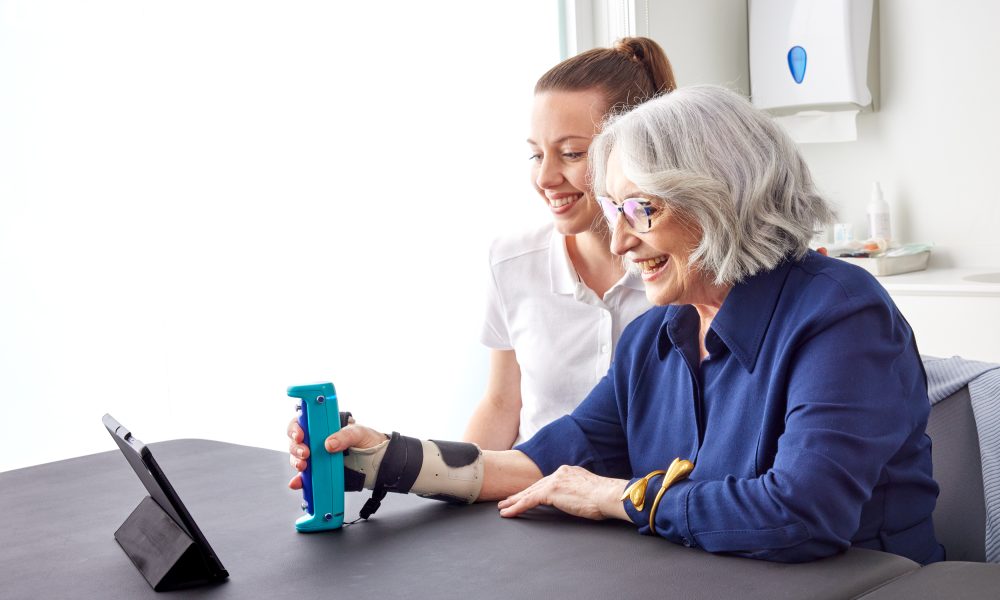
Harnessing its power to optimise outcomes in neuro-rehab
Swiss robotics manufacturer Hocoma has launched the ArmeoSpring Pro: the latest development in upper limb rehabilitation technology. The new ArmeoSpring Pro exoskeleton aims to deliver intensive, high-quality and repetitive movement therapy, improving motor recovery and train the core movement patterns that are used in activities of daily living. Patented TrueG technology provides powered continuous arm [...]
A team of researchers have developed a new method for controlling lower limb exoskeletons using deep reinforcement learning. This method allows for more robust and natural walking control for sets of lower limb exoskeletons. Advances in wearable robotics are paving the way in helping to restore mobility for those who have difficulties with movement. However, [...]

Folia Health is on a mission to collect better data. The US company’s co-founder spoke to NR Times about the data gap in neurological care, patient-centric research and the importance of keeping data in the hands of patients.
The healthcare sector is becoming increasingly data-driven as the likes of AI, remote monitoring and wearable technologies continue to develop at a rapid pace. However, the founder of health-tracking app Folia Health, Nell Meosky Luo, told NR Times that while the industry continues to focus its energy on advanced data analytics techniques, more focus should be given to the quality of the data. “There’s this theory that healthcare should be more data-driven but I think what a lot of people don't talk about is the fact that we're not collecting good enough data,” Folia Health co-founder and CEO, Nell Meosky Luo told NR Times.


