



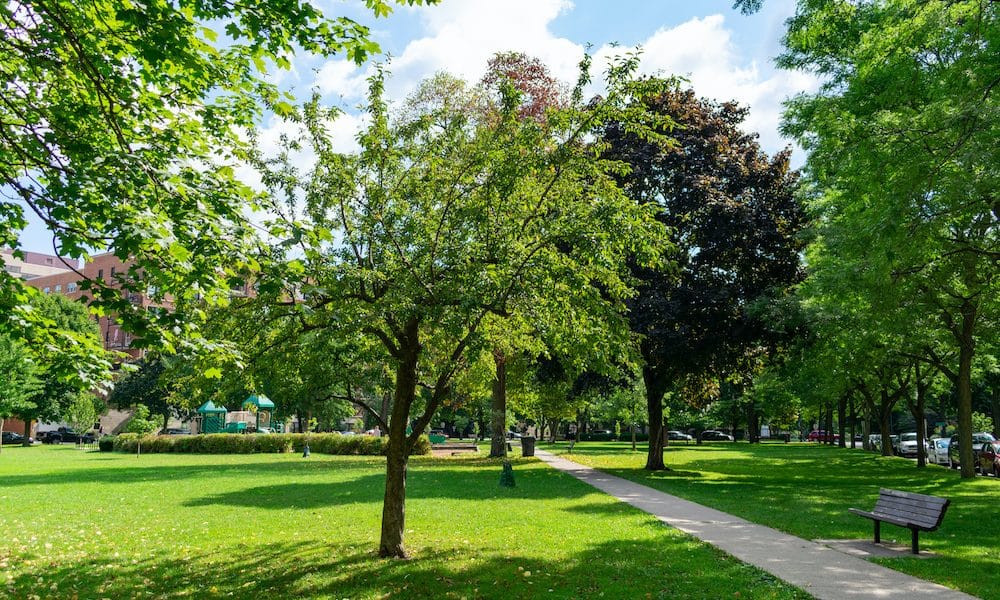
People who live near green space are at a lower risk of having a stroke, new research has revealed.
The chance of someone having an ischaemic stroke is 16 per cent lower for those who have green space less than 300 metres from their home, through the impact of lower pollutant levels.
The study took into account information on exposure to three atmospheric pollutants linked to vehicle traffic in more than 3.5million people from Catalonia, aged over 18 who had not had a stroke prior to the start of the study.
Specifically, it analysed the impact of the levels of particulate matter under 2.5 microns (PM2.5), nitrogen dioxide (NO2) and soot particles at the place of residence of each of the people studied.
The number and density of green spaces – which have recently been shown to lower anxiety and depression – within a 300-metre radius of their homes was also studied.
The results from the study – by the Hospital del Mar Medical Research Institute, Hospital del Mar, the Catalan Health Quality and Assessment Agency (AQuAS) from the Catalan Government’s Department of Health and the Barcelona Institute for Global Health (ISGlobal) – indicate a direct relationship between increased levels of NO2 in the atmosphere and the risk of ischaemic stroke.

For every increase of 10 micrograms (µg) per cubic metre, this risk increases by four per cent.
The same happens when PM2.5 levels increase by 5 µg/m3. In the case of soot particles, the risk increases by five per cent for every 1 µg/m3 increase in the atmosphere.
These figures are the same for the entire population, irrespective of other socio-economic factors, age or smoking habits.
“The study demonstrates the importance of environmental determinants in stroke risk,” explains Dr Carla Avellaneda, a researcher in the Neurovascular Research Group at IMIM-Hospital del Mar and one of the main authors of the study.
“Given that it is predicted that the incidence, mortality and disability attributed to the disease will increase in the coming years, it is important to understand all the risk factors involved.”
Previous studies by the same group had already provided evidence on the relationship between factors such as soot or noise levels and the risk of suffering a stroke and its severity. All these factors act as stroke triggers.
In contrast, having an abundance of green spaces within the same radius from the home directly reduces the risk of having a stroke.
“People who are surrounded by greater levels of greenery at their place of residence are protected against the onset of stroke,” says Dr Avellaneda.
Exposure to green spaces is generally considered to have beneficial effects through a variety of mechanisms, such as stress reduction, increased physical activity and social contact, and even exposure to an enriched microbiome.
Dr Jaume Roquer, head of the neurology service at Hospital del Mar and coordinator of the Neurovascular Research Group at IMIM-Hospital del Mar, adds: “This study demonstrates the real impact that environmental aspects have on the health of the Catalan population.
“In view of the effects of atmospheric pollution, the lack of green spaces, noise, and so forth, more efforts and populational strategies are needed to reduce its impact.
“Its harmful effects are permanently and globally damaging.
“We must strive to achieve more sustainable towns and cities where living does not mean an increased risk of disease.”


