



Condition ›
Dementia
Dementia diagnosis, care and research.
 Dementia21 Jul
Technology in the care system has come a long way, with the COVID-19 pandemic highlighting the need for more remote assistive technology.
Although there is no cure for degenerative diseases like dementia, utilising technology can ease the burden on both carers and patients, particularly those living on their own. Dementia20 Jul
A student from the Edinburgh Napier University has created a reminiscence therapy tool kit which is designed to help dementia patients recall past memories.
The Forget Me Not Box contains a number of tools that are used to activate the five senses, bringing joy to those with dementia while also helping retain their identity. The kit is fully customisable so patients can explore memories and senses that are unique to them. Its lid allows photographs to be displayed while the built-in speaker can play a patient’s favourite songs as well as voice notes from family and friends. The box’s taste cards come with photographs and descriptions of a person’s favourite foods, while the scent bottles allow them to recall familiar smells such as similar perfumes. Dementia20 Jul
A team of scientists are exploring if pauses, pitch and voice intensity could predict the development of Alzheimer’s Disease.
It is thought that people with the disease tend to speak slower and pause more often as they try to find the right words. The Alzheimer’s Society in the UK estimates that 850,000 people were living with dementia in 2019. It represents 1 in every 14 people aged 65 or over. It is thought this could rise to 1.5 million by 2040. The study The scientists used three machine-learning algorithms to assess voice data from 24 participants diagnosed with Alzheimer’s disease. They compared this to 99 participants without the disease. All those who took part were over the age of 65. Dementia19 Jul
A campaign group that promotes the use of music in care for dementia patients has formed a new partnership with one of the UK’s leading music organisations to promote its power.
Music for Dementia works with over 200 different organisations to show how integral songs and melodies can be for those with the disease and they have now added UK Music to its list. Dubbed the ‘Power of Music’, the partnership is looking to get more groups to recognise the impact this can have when it comes to improving overall health and wellbeing. Grace Meadows, campaign director at Music for Dementia, explained to NR Times a bit more about the collaboration. “It is a national campaign,” she said. “What we do is we advocate and call for music to be made an integral part of dementia care. Dementia12 Jul
Conservative MP Andrew Bowie is calling for the UK to use the lessons it has learned from COVID-19 and use them for research into dementia.
In May he spoke about the topic to his peers in Parliament as part of a general discussion to mark Dementia Awareness Week. Here the representative for West Aberdeenshire and Kincardine drew upon his own experiences with the disease, with both his grandmothers having battled with it. Bowie said both women went from ‘animated and fun’ people to a shadow of their former selves as dementia stripped them of their personalities. He is now calling on the government to increase funding for dementia research and help lead the way for finding a cure for the disease.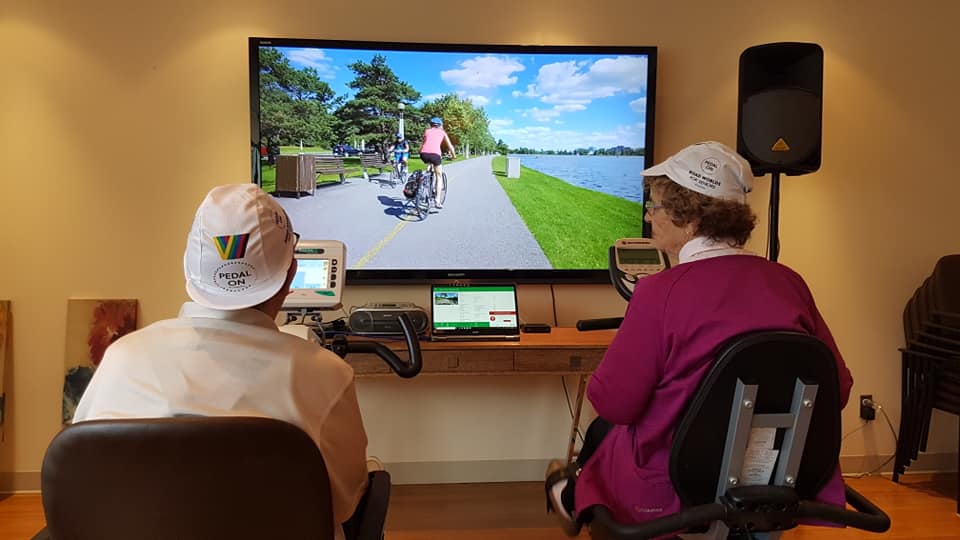 Dementia6 Jul
Cycling apparently boomed during last year's lockdowns as frustrated families sought to make the most of their exercise window; and the quieter roads as commuting ground to a halt.
Another cycling revolution, meanwhile, is underway in care homes, as new tech enables residents to unleash their pedal power and experience the open road - albeit on a screen. Motiview, designed by Norwegian firm Motitech, offers users the opportunity to cycle down the streets from their memories, revisit towns they once knew or explore destinations around the world via its video simulation system, all from the comfort of their own chair, using specially adapted exercise bikes Dementia6 Jul
In dementia cases, the instinct to look after and nurture something or someone can be among the last things to leave a person. People with the neurodegenerative condition may hold dolls while in care, for example, as their brain recognises them as objects requiring their care and attention.
While pets can also help to satisfy this need, taking care of them may be too much responsibility for many with the disease. A new solution is emerging, however, in the form of robotic animals. Dementia28 Jun
An online calculator has been created which empowers older people to better understand their brain health and how they can reduce their risk of being diagnosed with dementia in the next five years.
The calculator, built and validated by Canadian researchers, enables individuals aged 55 and over to assess themselves using the online tool at projectbiglife.ca. Dementia is the biggest cause of death in the UK and there are currently around 850,000 people living with the disease. This figure is projected to rise to 1.6million by 2040. While there is no cure for dementia, around a third of dementia cases may be preventable through lifestyle factors like physical activity, healthy eating, reducing alcohol and tobacco use, and managing conditions like diabetes and high blood pressure. Dementia23 Jun
A specialist neurological care provider which has supported people for over 25 years is moving into dementia care with the opening of a dedicated unit on its site.
Chase Park Neuro Centre has opened The Villa, an 11-bed residential dementia care facility, as the latest phase of investment in its offering to people with neurological conditions from across the North of England. The Villa has been repurposed as a dedicated dementia unit, having previously been a nursing suite on the site in Whickham, near Newcastle, with the first admissions expected in July. Recruitment is ongoing for new dementia care and therapy staff to add to its 90-strong team, with the addition of Paul Smith as Chase Park operations director a particularly significant move in helping to shape its dementia provision. Dementia21 Jun
More than 50,000 people have signed a petition to ask the UK government to double its funding for dementia research and keep the promises it made two years ago. Boris Johnson initially said there would be £160 million invested into the sector in the 2019 Conservative manifesto, but there has been a lack of movement in this area since. This has spurred the Alzheimer’s Research UK charity to launch the petition, calling on Number Ten to help fund possible treatments for dementia. The pandemic has been particularly hard for those with the disease, with a quarter of COVID-related deaths coming from this group.


