



Research
New studies, trials and evidence in neurorehabilitation.
 Parkinson's27 Oct
Researchers have directly seen and measured the protein clusters thought to spark Parkinson’s disease for the first time, marking a major milestone in understanding the condition. These microscopic clusters, known as alpha-synuclein oligomers, have long been suspected as the starting point for Parkinson’s but had remained undetectable in human brain tissue until now. A team [...]
 Multiple sclerosis24 Oct
Having a higher body mass index (BMI) at the time of multiple sclerosis (MS) diagnosis is linked to faster disability progression, particularly when excess weight has been present since early adulthood. A Swedish study of 2,940 people with relapsing forms of MS found that those with persistently elevated BMI – a measure of body fat [...]
 MND / ALS23 Oct
Standard MRI scans of the tongue could help detect and monitor motor neurone disease (MND) at an earlier stage, new research has found. The study discovered that people living with MND who have difficulty speaking or swallowing tend to have smaller tongue muscles, which could provide an early indication of the neurodegenerative disease. MND, also [...]
 Stroke22 Oct
Doctors should measure patients’ neck circumference to assess stroke risk, as larger measurements could indicate serious health problems, experts have warned. Two lecturers at Kingston University say neck size offers a more accurate insight into health than body mass index (BMI) or waist-to-hip ratio. They note that neck circumferences of 17 inches (43cm) or more [...]
 Stroke22 Oct
NR Times explores the latest business and pharmaceutical developments in the world of neurorehabilitation. New partnership to distribute of MedRhythms devices for stroke and Parkinson’s Neurorehabilitation company MedRhythms has entered a strategic partnership with Edwards Health Care Services (EHCS), a leading provider of direct-to-home medical products. The partnership enables nationwide distribution of MedRhythms' currently available [...]
 Stroke22 Oct
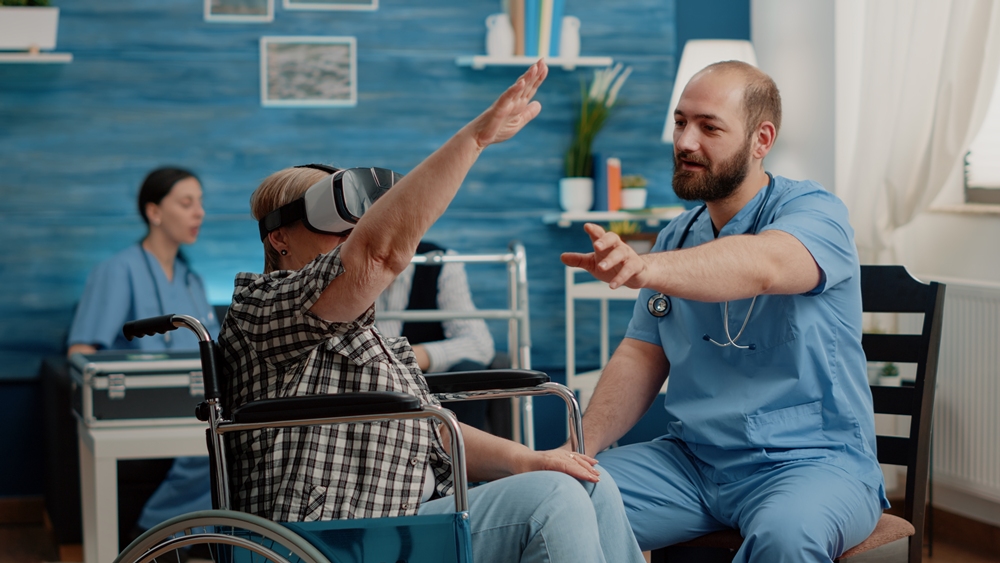
A new virtual reality training task developed by researchers in Finland shows promise for helping stroke survivors with visuospatial neglect, a condition that affects awareness of one side of space. The VR-based rehabilitation tool combines audiovisual cues with physiotherapy exercises to support recovery. Visuospatial neglect (VSN) affects about 30 per cent of stroke survivors and [...]
 Brain injury21 Oct
Current brain injury assessment tools fail to consider the effects of hormonal changes during menopause, potentially delaying recovery or increasing symptom burden in women, new research suggests. This omission may result in missed diagnoses, poor risk assessment and inadequate treatment for menopausal women recovering from TBIs. Researchers from the University of Florida College of Public [...]
 Multiple sclerosis20 Oct
Multiple sclerosis may begin damaging the brain up to seven years before symptoms appear, researchers say, showing immune activity starts earlier than previously thought. By analysing more than 5,000 blood proteins, scientists have mapped when MS begins attacking the myelin sheath — the fatty layer protecting nerve fibres — and identified potential diagnostic markers. Myelin [...]
 Parkinson's16 Oct
People with Parkinson’s are receiving a new investigational treatment after a successful study demonstrated the therapy’s safety in non-human primates and refined the method for its delivery. Biotechnology company Aspen Neuroscience said it would enrol a third group of participants in its ASPIRO trial after the first four patients safely tolerated the therapy. The Phase [...]
 Research14 Oct
By Stephanie McDonald, UPCM clinical lead, Unite Professionals Unite Professionals strive to provide high-quality case management and as a result, have considered numerous ways to ensure that this is achieved. One innovative idea is the implementation of a unique outcome measure tool which delivers a number of benefits. Outcome measures are tools which are used [...]


