About Andrew Mernin

This author has not yet filled in any details.
So far Andrew Mernin has created 640 blog entries.

Does depression increase risk of MS progression?

Depression is unlikely to play a role in making disability progression worse in people with multiple sclerosis (MS), a new study published in Scientific Reports has found.

Researchers from Swansea University, University of Cambridge and Queen Mary University of London conducted the UK-wide study to find out if depression and/or anxiety put people with MS at greater risk of disability progression.
By |2024-07-04T17:33:42+01:0024 May 2023|Multiple sclerosis|

Creating a bright new reality in neuro-rehab

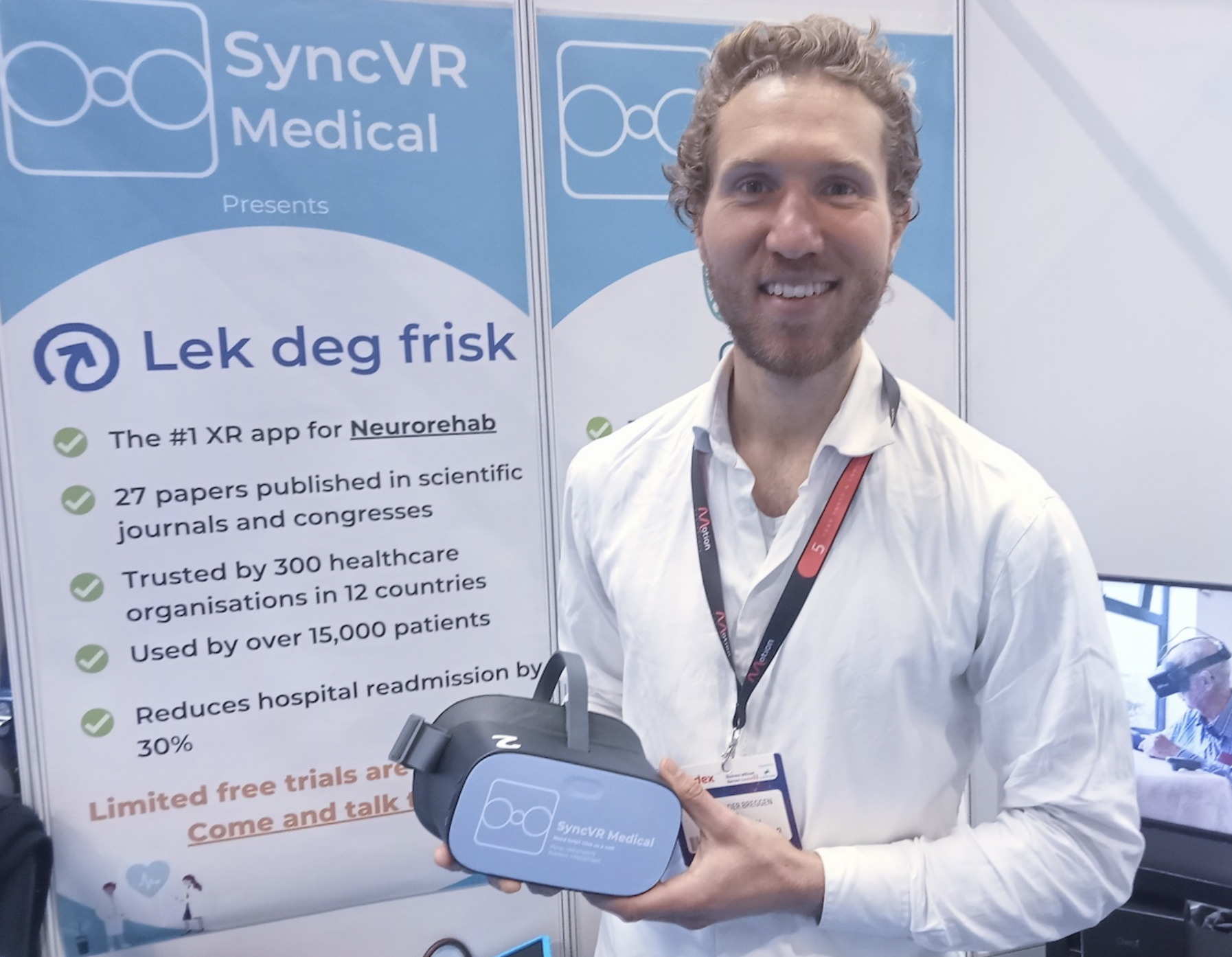
Extended reality (XR) could revolutionise neuro-rehab, but challenges remain – including in terms of lack of access and the need for more clinical evidence. But Floris van der Breggen, founder of SyncVR Medical, is an entrepreneur on a mission to unlock its potential by building the “Netflix of health XR”, as Andrew Mernin reports. Putting on a VR headset at a busy international exhibition feels disconcerting at first. The white light of the vast conference centre is replaced by moonlight, which catches the surface of a virtual lake. While all around, rehab professionals sweep past on their way to the next presentation, gentle music ushers me into a purple forest. “This can be used during surgery, needle procedures or pain episodes,” says a voice breaking the tranquillity. It belongs to Floris van der Breggen, founder of SyncVR Medical. Sign up to NR Times to read this feature in full. Find out how Floris aims to transform rehab interventions through XR and watch the platform in action.

By |2024-07-04T17:33:43+01:0023 May 2023|Uncategorised|

“We’re in a completely different phase of MS now”

As medical director of Holy Name’s renowned MS Center in New Jersey, Dr Mary Ann Picone is a hugely influential figure in the movement to advance MS treatments. NR Times speaks to her about challenges, opportunities and new developments in the MS field. Not so long ago, being diagnosed with MS meant an end to life as you knew it. So bleak was the outlook, recalls Dr Mary Ann Picone, that America’s MS community came up with a phrase soaked in gallows humour – “diagnose and adios”. Although as recently as the 1980s there were virtually no treatment options for clinicians to turn to, however, there are now numerous; and Dr Picone, who has been on the frontline of MS drug development in the decades since, has played an important role in helping to drive this. Read on to find out about the emerging therapies that will shape MS treatment in the coming years and Dr Picone's views on the road ahead in MS research.


By |2024-07-04T17:33:46+01:0012 May 2023|Research, Multiple sclerosis|

“People with Parkinson’s don’t want more medication – they want to overcome the barriers they face every day due to anxiety”

Studies suggest that as many as six in 10 people with Parkinson’s experience anxiety. Yet this and other non-motor challenges are largely overlooked by traditional interventions, with motor issues perhaps understandably prioritised among clinicians.

Having listened to urgent calls from within the Parkinson’s community for this to change, however, Christopher Lovegrove is on a mission to develop a new anxiety intervention; shaped, not by general population anxiety approaches, but by people living with the challenges of Parkinson’s every day. An occupational therapist by background, Christopher is an NIHR clinical doctoral research fellow at the University of Plymouth and Royal Devon University Healthcare NHS Foundation Trust. Here he talks to NR Times about his vision and the progress made so far in realising it.
By |2024-07-04T17:33:49+01:005 May 2023|Parkinson's, News|

Interview: How voice AI will change neuro diagnosis

The voice AI platform Canary Speech has achieved an accuracy of 96 per cent in recognising early signs of Huntington’s disease. NR Times spoke to CEO and co-founder Henry O’Connell about its potential role in neuro-rehab. 

Speech is the most complex motor function in the human body and a key indicator of disease progression in patients with neurological conditions. As a neurological disease impacts the muscular system it leads to changes in patients’ voice and language. These changes occur gradually, beginning as subtle clues before developing into more noticeable symptoms as the disease progresses. Parkinson’s patients, for example, might slur words, mumble or struggle with articulation, while people with Alzheimer’s may begin to forget words as their condition deteriorates. The minute changes to speech that begin at the early stages of neurological diseases are difficult to spot. But, as a new era of AI and natural language processing technology (NLP) emerges, new platforms are showing promise for identifying dysarthria at a much earlier stage. One of the leaders in this field is Canary Speech, a voice biomarker platform that has already had success in screening for mood, stress, and energy levels using a single 20-second audio clip. Now, the company is turning its attention to neurological diseases as it seeks to use the same technology to detect the first signs of Parkinson’s, Huntington’s and Alzheimer’s Disease. Sign up to NR Times now to read our Canary Speech interview in full.
By |2024-07-04T17:59:09+01:003 May 2023|News, Interviews, Insight|

On a mission to close the ADHD diagnosis gap

Brain injury and ADHD share a complex relationship, with research evidence highlighting the disorder among neurobehavioural  complications of TBI and amid widespread recognition that more studies are needed to shed light on this complex picture. NR Times reports on a pioneering approach to ADHD which aims to revolutionise management of the condition.

Children with traumatic brain injury have a heightened risk of developing ADHD, and recent research suggests that it may not develop until years later. A separate study (Gerring et al, 1998) presents ADHD secondary to TBI as occurring in 20 to 50 per cent of individuals post-injury. Meanwhile, ADHD diagnoses are on the up. In the US, the National Health Interview Survey estimated the prevalence in children aged four to 17 years to be around 10 per cent in 2016, up from six per cent in the 1990s. And this trend seems to have continued, with more recent figures up to 2019 from the Centers for Disease Control and Prevention showing that ADHD has recently been diagnosed in 13 per cent of children aged 12 to 17 years in US. Against the backdrop of this trend, ADHD Online has emerged as the only organisation in the US to offer ADHD assessment online that is compliant with the Health Insurance Portability and Accountability Act (HIPAA); which protects sensitive patient health information from being disclosed without the patient’s consent or knowledge. The platform provides certified results from licensed psychologists. NR Times spoke to CEO Zach Booker and senior clinical staff at the company about its novel approach to ADHD and their views on the outlook for ADHD management.
By |2024-07-04T17:33:53+01:0027 April 2023|News|

In search of the lost and forgotten rehab patients

Rehab physician and former health system leader Dr Gerda Maissel now dedicates her time to the forgotten complex care patients lost in the mechanisms of American health. Here she tells NR Times about her My MD Advisor mission.

Dr Gerda Maissel is something of a guiding light for neuro-rehab patients lost in the American healthcare system. The former rehabilitation physician who later spent 12 years in health system leadership, dedicates her time to helping people with complicated healthcare problems navigate their way back to an appropriate pathway through her enterprise, My MD Advisor. “People get lost in the system a lot here,” she says from her home in New York State. “Fundamentally, the system which helped people with severe injuries in the past, now provides very short lengths of stay in inpatient, acute rehab settings; and so, people get dumped into sub-acute rehab, where there's not even remotely the level of expertise needed." Read on for more on the challenges facing rehab patients on the wrong pathway and Dr Maissel's views on how to overcome them.
By |2024-07-04T17:59:10+01:0020 April 2023|News, Interviews, Insight|

“I’m a terrified patient, I know exactly what I’m talking about”

Her life's work has been to rid the world of MS and now Nancy Davis believes she’s getting ever closer. NR Times meets the tireless Race to Erase MS founder who has been the catalyst for 20+ FDA-approved MS therapies and US$50m in research funding.

A well-worn phrase from success coaching parlance says that the best way to take the island, is to ‘burn the boats’. Out of absolute necessity comes achievement – and after the point of no return, there is nothing to be done but move forward and get to it. That point for Nancy Davis came in 1991 when, at age 33, she was diagnosed with MS. Faced with a relative treatment black-out by today’s standards, and against the backdrop of an unhappy marriage, the fate of her three children as the disease progressed was necessity number one. Then there was the prospect of her own existence. A doctor said the best she could hope for was enough mobility function to operate a TV controller. And so sparked a race against time, not only to save herself, but to help others with MS avoid a similarly bleak outlook. Read on to find out how Nancy's journey since has helped to bring numerous new MS treatments to market and why she believes a cure for MS could be just five years away.
By |2024-07-04T17:59:10+01:0018 April 2023|Interviews, Insight, Multiple sclerosis|

Leading the race to stop neurodegenerative disease progression

NR Times meets Coya Therapeutics’ founder and CEO Howard Berman as he closes in on his mission to halt ALS / motor neurone disease and other neurodegenerative conditions.  

“Even if we see results that are half as good what we’ve already seen, this is going to change the way ALS is treated,” says Howard Berman, founder and CEO of Coya Therapeutics. The results he points to, which caused much excitement in the neuroscience research community last month, showed four people with ALS treated with Coya’s immune modulating therapy experienced a significant slowing of disease progression. ALS is the most common form of motor neurone disease (MND), while, in the US, it is also the umbrella term for MND. Coya's therapy has emerged from the Nasdaq-listed firm’s pursuit of treatments based on the enhancement of the function of regulatory t cells (Tregs) in the immune system. Read on to find out how Coya aims to build on its early promising results to change the outlook for people with ALS / motor neurone disease and wider neurodegenerative diseases. Also, we hear how the neuro-rehab community is helping to drive new treatment possibilities and why Tregs are becoming so important to our understanding of brain conditions. 
By |2024-07-04T17:33:54+01:0013 April 2023|Therapy, Research, News|

Lessons learned: Child brain injury – truancy, expulsion and unemployment

NR Times reports on progress in unpicking the relationship between childhood TBI and struggles in education and the workplace.

The impact of childhood traumatic brain injuries on school years and working life is well documented; with behavioural, planning and learning challenges among many factors which can adversely affect young people. Often these experiences happen years after their injury, as brains develop and educational life requires ever-more independence. A spokesperson for the American Academy of Pediatrics explains to NR Times: “Mild traumatic brain injury can have an effect on how the brain functions. “If the brain isn’t functioning normal, students can struggle with learning new information, recalling information, focusing and concentrating to their normal abilities. “Communication is key in all mild TBI patients as most of the symptoms are not outwardly visible. “Since you can’t see their struggles it is important for kids and the parents to be able to communicate with the school staff and teachers as to how their symptoms are specifically causing them struggles in school.” But evidence linking TBI and specific negative outcomes, such as exclusion, absenteeism and unemployment, is lacking. This is changing, however, as NR Times reports.
By |2024-07-04T17:33:55+01:0031 March 2023|News, Brain injury|
Go to Top